
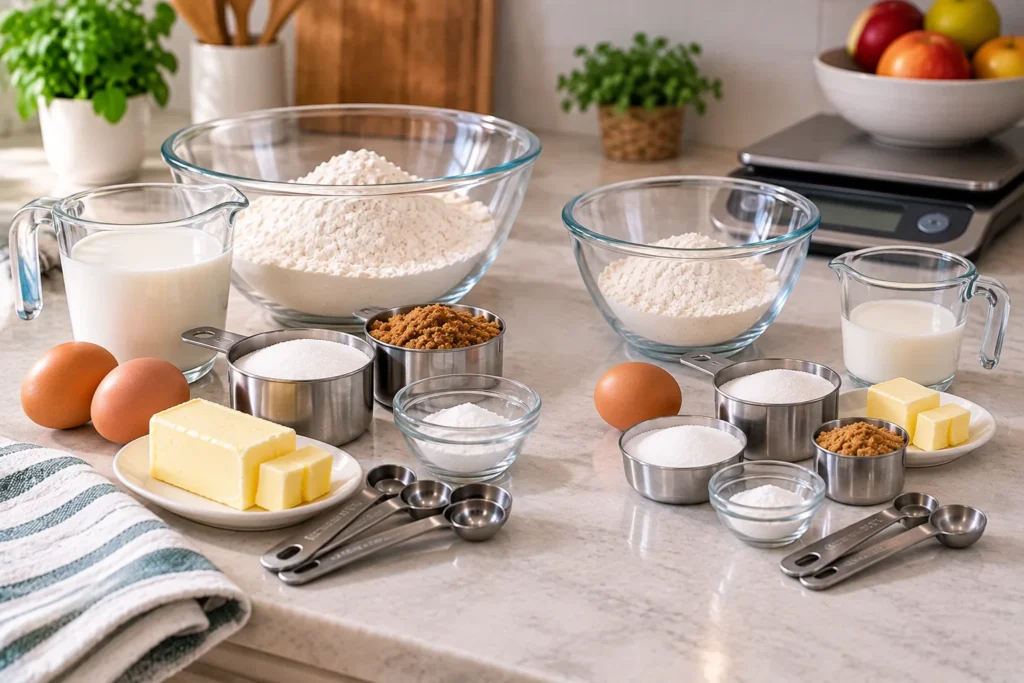
Learning how to halve a recipe is mostly a matter of dividing every ingredient by two. The easy measurements, such as 2 cups becoming 1 cup, take seconds. The trouble starts when the recipe calls for 3/4 cup, 1/3 cup, 1 tablespoon or a single egg.
The basic rule is simple:
Original ingredient amount ÷ 2 = amount for a half recipe
For everyday soups, casseroles, sauces and most stovetop dishes, that usually works very well. Baking needs a little more attention because pan size, eggs and baking time can affect the result.
If you would rather skip the fraction calculations, the Kitchen Answers Recipe Scaling Calculator can scale the entire recipe for you.
Quick Half Recipe Measurement Chart
Here are some of the measurements people most often get stuck on.
| Original amount | Half the amount |
|---|---|
| 4 cups | 2 cups |
| 3 cups | 1 1/2 cups |
| 2 cups | 1 cup |
| 1 1/2 cups | 3/4 cup |
| 1 cup | 1/2 cup |
| 3/4 cup | 6 tablespoons |
| 2/3 cup | 1/3 cup |
| 1/2 cup | 1/4 cup |
| 1/3 cup | 2 tablespoons + 2 teaspoons |
| 1/4 cup | 2 tablespoons |
| 2 tablespoons | 1 tablespoon |
| 1 tablespoon | 1 1/2 teaspoons |
| 2 teaspoons | 1 teaspoon |
| 1 1/2 teaspoons | 3/4 teaspoon |
| 1 teaspoon | 1/2 teaspoon |
| 3/4 teaspoon | 3/8 teaspoon |
| 1/2 teaspoon | 1/4 teaspoon |
| 1/4 teaspoon | 1/8 teaspoon |
These conversions use standard U.S. kitchen relationships. NIST lists approximately 240 mL per U.S. cup, 15 mL per tablespoon and 5 mL per teaspoon.
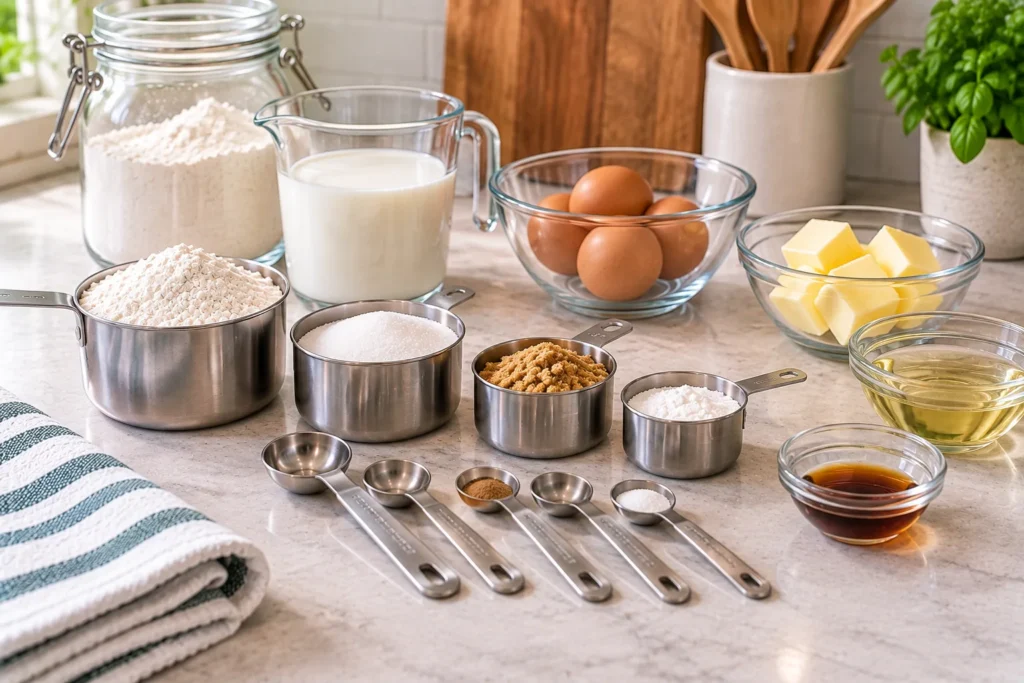
How to Halve a Recipe Step by Step
Before you start cooking, go through the entire ingredient list and calculate every new amount.
Do not halve ingredients as you add them. That works beautifully until you forget whether the milk was already divided and discover you have made a three-quarter recipe by accident.
A simple approach is:
- Read the complete recipe.
- Write the new amount beside every ingredient.
- Check awkward fractions before you start.
- Decide how you will handle eggs.
- If baking, choose the pan before mixing the batter.
- Keep the original cooking temperature unless the recipe specifically requires something different.
- Start checking for doneness earlier than the original recipe suggests.
For complicated recipes, rewriting the ingredient list first is usually worth the minute it takes.
How Do You Halve 3/4 Cup?
Half of 3/4 cup is 3/8 cup.
Most kitchens do not have a 3/8-cup measure, so the practical equivalent is:
6 tablespoons
Why?
A U.S. cup contains 16 tablespoons. Three-quarters of a cup is 12 tablespoons, and half of 12 is 6.
This is often much easier than trying to visualize 3/8 of a measuring cup.
How Do You Halve 2/3 Cup?
Half of 2/3 cup is 1/3 cup.
This one is conveniently simple because most measuring-cup sets already include a 1/3-cup measure.
How Do You Halve 1/3 Cup?
Half of 1/3 cup is 1/6 cup, which is not a common kitchen measuring cup.
A practical measurement is:
2 tablespoons + 2 teaspoons
This is one of those conversions that is useful to write down rather than attempting mental arithmetic while something is already sizzling on the stove.
How Do You Halve 1/4 Cup?
Half of 1/4 cup is 1/8 cup.
The easiest kitchen equivalent is:
2 tablespoons
How Do You Halve 1 Tablespoon?
Half of 1 tablespoon is:
1 1/2 teaspoons
Since a tablespoon contains 3 teaspoons, dividing it in half gives 1.5 teaspoons.
How Do You Halve 3/4 Teaspoon?
Half of 3/4 teaspoon is:
3/8 teaspoon
If you own a 1/8-teaspoon measuring spoon, use:
1/4 teaspoon + 1/8 teaspoon
If you do not, a 1/4 teaspoon plus a small additional amount is reasonable for an ordinary savoury seasoning.
For baking powder, baking soda or another ingredient where accuracy matters, a proper 1/8-teaspoon measure is a better choice.
What Should You Do With Half an Egg?
This is probably the most common awkward part of halving a baking recipe.
If the original recipe calls for one large egg, do not try to divide the white and yolk by eye.
Instead:
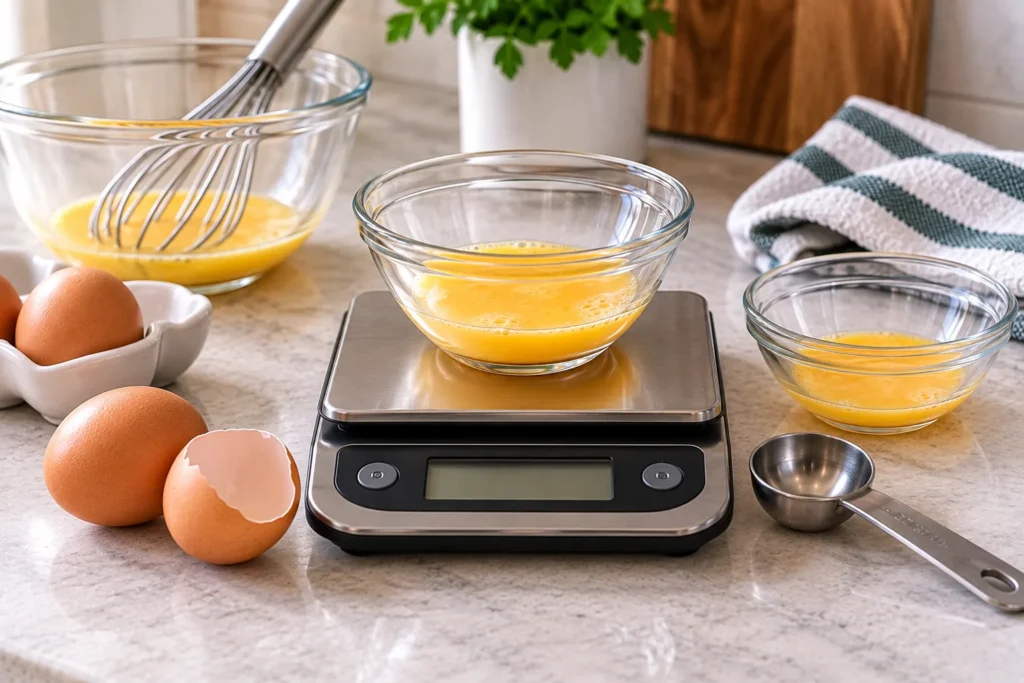
- Crack the egg into a small bowl.
- Whisk the yolk and white together.
- Measure half of the beaten egg.
King Arthur Baking notes that a large egg without the shell weighs about 50 grams, so half a large egg is approximately 25 grams. Without a scale, half is roughly a scant 2 tablespoons of beaten egg.
If a recipe calls for 3 eggs and you want half the recipe, use:
1 whole egg + half of a second beaten egg
For 2 eggs, simply use 1.
What about an egg yolk or egg white?
You can use the same method.
Whisk the yolk or white enough to make it uniform, then divide it by weight.
King Arthur gives approximate weights of 14 grams for a large egg yolk and 35 grams for a large egg white, although individual eggs vary slightly.
For everyday cooking, exact egg division is rarely important. For cakes, cookies, custards and other baking recipes, weighing is much more reliable.
Does Halving a Soup, Stew or Sauce Work the Same Way?
Mostly, but watch evaporation. Halving a stew halves what’s in the pot, but not necessarily its exposed surface area if you switch to a smaller pot, so it can reduce and thicken faster than expected. Keep an eye on it rather than assuming it will take exactly half as long to reach the right consistency, and taste for seasoning partway through rather than halving salt and spice quantities blindly, since those don’t always scale in a straight line either.
What About Rice, Pasta or Other Grains When You Halve a Recipe?
Cooking liquid for rice and grains doesn’t always divide as cleanly as the grain itself does. Evaporation, pot size and the specific grain’s cooking method all affect how much liquid is actually needed. Halve the grain, but check the liquid ratio for that specific grain and method rather than assuming half the original liquid will behave identically in a smaller pot.
Should You Halve Salt, Spices and Seasonings?
Start by halving them.
If the original recipe uses:
- 2 teaspoons salt, use 1 teaspoon
- 1 teaspoon oregano, use 1/2 teaspoon
- 1/2 teaspoon pepper, use 1/4 teaspoon
For savoury cooking, you can always start slightly cautiously and adjust the seasoning near the end.
Baking is different.
Salt, baking powder and baking soda contribute more than flavour, so measure them accurately rather than reducing them casually.
Very small quantities can become awkward. If halving gives you 1/8 teaspoon, having an inexpensive 1/8-teaspoon measuring spoon can be surprisingly useful.
Can You Just Halve Every Ingredient in a Baking Recipe?
Usually, but the ingredients are only part of the job.
A halved cake, brownie or quick bread recipe may need:
- a smaller baking pan
- a different baking time
- careful egg measurement
- more attention to visual signs of doneness
King Arthur Baking specifically recommends considering pan area when reducing a baking recipe rather than simply pouring half the batter into the original full-size pan.
If the layer of batter becomes much thinner than intended, it can bake very differently.
What Size Pan Should You Use for Half a Recipe?
Try to keep the depth of the batter reasonably close to the original recipe.
A useful method is to compare the bottom area of the pans.
For a rectangular or square pan:
length × width = pan area
A 9 x 13-inch pan has a bottom area of:
9 × 13 = 117 square inches
Half is:
58.5 square inches
An 8-inch round pan has an area of about 50 square inches, while a 9-inch round pan is about 64 square inches. Either can therefore be a reasonable choice for many recipes originally baked in a 9 x 13-inch pan and cut in half.
King Arthur specifically notes that a half recipe from a 9 x 13-inch pan can often be baked in an 8-inch or 9-inch round pan.
The exact best pan still depends on the recipe.
Can you bake half the batter in the original pan?
Sometimes, but the result will be much thinner.
Brownies, bars and cakes can bake faster and may have a noticeably different texture.
A smaller pan usually gives a result closer to the original.
Do You Cut the Cooking Time in Half Too?
No.
Halving the ingredients does not automatically mean halving the cooking time.
This is especially important in baking.
King Arthur notes that there is no reliable universal formula for reduced baking times. Smaller batches often bake faster, but the change can vary substantially depending on the recipe and pan.
For a reduced baked recipe, they suggest beginning to check around halfway through the original baking time, then continuing to check regularly until the normal signs of doneness appear.
For example, if the original cake says:
Bake 45 to 50 minutes
do not automatically set the timer for 25 minutes and remove it.
Instead, begin checking early and use the recipe’s normal signs of doneness.
That might include:
- a golden surface
- edges pulling slightly from the pan
- a toothpick coming out clean or with the expected crumbs
- the correct internal temperature when the recipe provides one
You can always give it another five minutes. You cannot negotiate with a cake that has already been baked into a brick.
What About Stovetop Cooking Time?
For soups, sauces, pasta dishes and skillet meals, the cooking time often stays fairly close to the original.
A smaller quantity may:
- come to a boil faster
- heat through faster
- reduce more quickly
- brown in less time
But onions still need time to soften, meat still needs to cook properly, and a sauce may still need time for flavours to develop.
Use the recipe’s appearance, texture and temperature instructions rather than simply dividing every cooking time by two.
Should You Halve the Oven Temperature?
No.
If a recipe says to bake at 350°F, halving the ingredients normally does not mean baking at 175°F.
Keep the recipe’s original oven temperature unless you are deliberately changing the cooking method or pan in a way that calls for a different temperature.
The quantity and time may change. The basic baking temperature usually does not.
Is a Kitchen Scale Helpful When Halving Recipes?
Very.
A kitchen scale is particularly useful when the original recipe is already written in grams.
If a recipe calls for:
- 500 g flour, use 250 g
- 300 g sugar, use 150 g
- 180 g butter, use 90 g
There are no awkward cup fractions to deal with.
A scale is also the easiest way to divide eggs accurately.
NIST recommends measuring ingredients by mass with an appropriate kitchen scale when accuracy is important, and notes that weighing can reduce measurement errors associated with volume measures.
If you need to convert a cup-based recipe to grams before scaling it, use the Kitchen Measurement Converter.
Our Cups to Grams Conversion Guide is also designed to help with ingredient-specific conversions once that article is live.
What About Packaged Ingredients?
Packages, cans and jars are easiest to divide by weight or volume.
If a recipe calls for a 14-ounce can of something, half is:
7 ounces
If it calls for 500 mL of stock, use:
250 mL
A kitchen scale can be useful for ingredients such as cream cheese, chocolate, canned pumpkin or other products that are awkward to divide by eye.
For liquids, use the measurement printed on the package rather than guessing where half the container happens to be.
Are There Recipes You Should Not Casually Halve?
Yes.
Ordinary dinner recipes, cookies, cakes and casseroles are usually straightforward to scale.
Home canning and food-preservation recipes require more caution.
Validated canning recipes rely on tested ingredient proportions, acidity, jar sizes, processing times and temperatures. Penn State Extension warns against altering tested canning formulations because changes can affect the safety of the finished food.
If you are preserving food for shelf storage, follow a tested recipe from a recognized food-preservation authority rather than applying ordinary recipe-scaling rules on your own.
Candy making and other temperature-sensitive recipes can also behave differently when the batch size and pan geometry change, so those deserve recipe-specific guidance.
A Simple Example of Halving a Recipe
Suppose the original pancake recipe calls for:
- 2 cups flour
- 2 tablespoons sugar
- 1 tablespoon baking powder
- 1 teaspoon salt
- 2 eggs
- 1 1/2 cups milk
- 4 tablespoons melted butter
For half a batch, use:
- 1 cup flour
- 1 tablespoon sugar
- 1 1/2 teaspoons baking powder
- 1/2 teaspoon salt
- 1 egg
- 3/4 cup milk
- 2 tablespoons melted butter
That is a good example of why most recipes are easy to halve once the awkward measurements are converted.
Kitchen Answers Tip
When you halve a recipe, rewrite the complete ingredient list before cooking.
Do not rely on doing the math as you go.
This is especially useful when the recipe contains similar ingredients in several places, such as sugar in both a cake and topping or butter in both dough and filling.
The Kitchen Answers Recipe Scaling Calculator is designed for exactly this situation. Enter the original quantity and the new serving amount, and it will handle the scaling before you start cooking.
Scale your recipe with the Recipe Scaling Calculator
Frequently Asked Questions
How do you cut a recipe in half?
Divide each ingredient quantity by two. Write the new amounts down before cooking, then consider whether the recipe also needs a smaller baking pan or earlier doneness checks.
What is half of 3/4 cup?
Half of 3/4 cup is 3/8 cup, which is easiest to measure as 6 tablespoons.
What is half of 1/3 cup?
Half of 1/3 cup is 1/6 cup, or 2 tablespoons plus 2 teaspoons.
What is half of 1 tablespoon?
Half of 1 tablespoon is 1 1/2 teaspoons.
How do you use half an egg in a recipe?
Whisk one large egg until evenly combined, then use about half. For the most accurate measurement, weigh 25 grams of beaten egg.
Do you halve baking time when you halve a recipe?
Not automatically. Smaller baked goods often cook faster, but there is no universal half-time rule. Start checking earlier and use the normal signs of doneness.
Do you halve the oven temperature?
No. Keep the original baking temperature unless the recipe specifically tells you otherwise.
Can you halve a recipe that calls for 3 eggs?
Yes. Use 1 whole egg plus half of another beaten egg.
Make Recipe Scaling Easier
Once you know the basic fractions, cutting most recipes in half is straightforward. The ingredients are usually the easy part. Eggs, tiny measurements, pan size and cooking time are where a little planning makes the biggest difference.
For any recipe that involves several awkward quantities, use the Kitchen Answers Recipe Scaling Calculator instead of working through every fraction yourself.
You can also browse more practical calculators and guides in Kitchen Tools.
Sources
The main baking and recipe-reduction guidance came from King Arthur Baking’s detailed testing on reducing recipes, including eggs, pan area and baking time.
NIST culinary measurement guidance was used for common kitchen-volume relationships and recommendations about weighing ingredients when greater accuracy is useful.
The home-canning caution is based on current Penn State Extension guidance about following validated canning recipes and not changing tested formulations or processing instructions.
King Arthur Baking: How to Reduce a Recipe
NIST: Culinary Measurement Tips
NIST: Cooking Measurement Equivalencies
Penn State Extension: Use Validated Recipes to Preserve Foods