
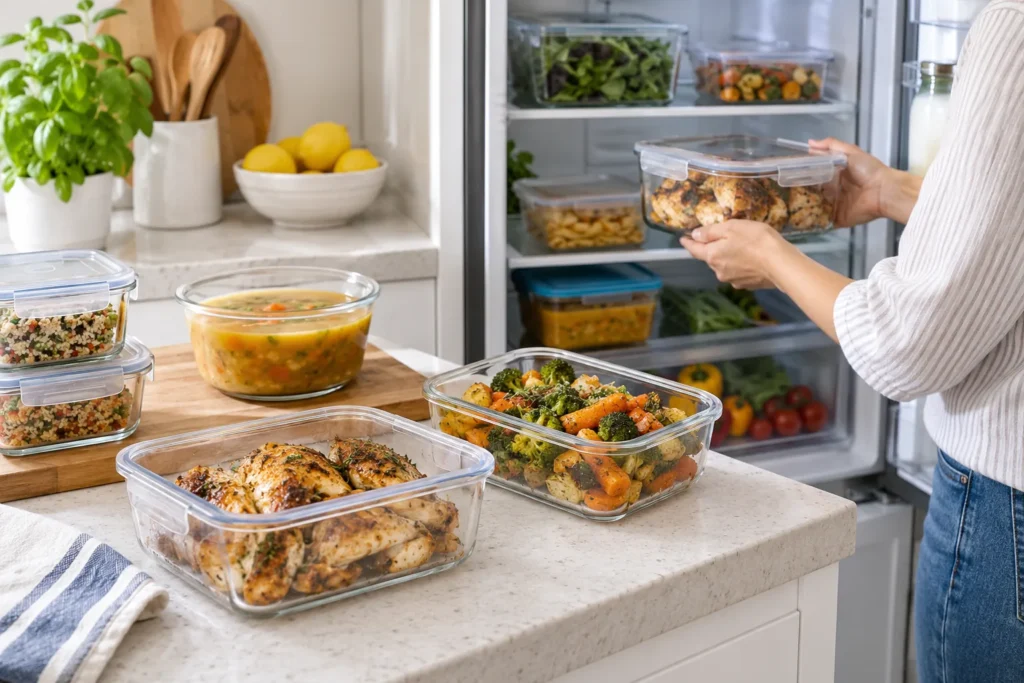
How long do leftovers last in the fridge? There is no single storage time that applies to every food or every country. In the United States, most cooked leftovers are generally kept for 3 to 4 days. Health Canada’s general leftover advice is more cautious at 2 to 3 days, although its food-specific storage chart gives 3 to 4 days for many cooked dishes. The UK recommends eating leftovers within 48 hours, Ireland says 2 to 3 days, and Australia recommends using most leftovers within 3 days.
New Zealand is more specific about what you plan to do with the food. Leftovers that will be reheated hot can generally be refrigerated for up to 4 days, while cooked leftovers normally eaten cold and rice-based leftovers should be used within 2 days.
So the familiar “leftovers last four days” rule is useful in some places, but it is not a universal rule.
Quick answer: how long do leftovers last in the fridge by country?
| Region | General refrigerated leftover guidance | Important exceptions |
|---|---|---|
| Canada | Usually 2 to 3 days | Many cooked dishes are listed at 3 to 4 days; soups 2 to 3 days |
| United States | 3 to 4 days | Some foods have their own storage times |
| United Kingdom | Within 48 hours | Freeze sooner if you will not use them |
| Ireland | 2 to 3 days | Keep refrigerated between 0°C and 5°C |
| Australia | Within 3 days | Cooked rice and pasta within 2 days |
| New Zealand | Up to 4 days if reheated hot | Cold cooked leftovers and rice-based leftovers within 2 days |
| WHO guidance | No longer than 3 days | General international guidance rather than food-specific advice |
Health Canada recommends eating general refrigerated leftovers within 2 to 3 days, while its detailed storage chart gives 3 to 4 days for cooked meat, stews, egg or vegetable dishes, cooked poultry and fish. Soups are listed at 2 to 3 days.
USDA recommends using most refrigerated leftovers within 3 to 4 days. The UK Food Standards Agency says to eat leftovers within 48 hours or freeze them. Ireland recommends 2 to 3 days. NSW Food Authority advises eating most leftovers within 3 days, with cooked rice and pasta used within 2 days.
The World Health Organization’s Five Keys to Safer Food manual advises that leftover food should not normally be refrigerated for longer than 3 days.
We’ve checked guidance for Canada, the US, the UK, Ireland, Australia and New Zealand directly. If yours isn’t listed, see how we research food storage guidance.
Why do leftover storage times vary by country?
Food-safety agencies do not all use exactly the same assumptions or safety margins.
Some publish one simple rule for most leftovers. Others give separate storage periods for different foods. New Zealand goes a step further by distinguishing leftovers that will be eaten cold from those that will be reheated.
That does not necessarily mean one country thinks another country’s advice is unsafe. It usually reflects different public-health guidance, temperature standards and how broadly the word “leftovers” is being used.
For Kitchen Answers, the practical approach is simple: follow the guidance for your region and the particular food whenever specific advice is available.
That is also why the Kitchen Answers Food Storage Time Finder asks for your region rather than giving everyone the same number.
When does the leftover storage clock start?
For home-cooked food, count from the day the food was cooked and refrigerated.
If dinner was cooked Monday evening and promptly refrigerated, Monday is the starting point. Do not wait until Tuesday morning to start counting just because that is when you first noticed the container.
For restaurant or takeout leftovers, refrigerate the food promptly after the meal and count from that day. You usually do not know exactly when every ingredient was originally prepared, so there is little reason to push takeout to the very end of a storage window.
Adding the date to the container takes a few seconds and saves the later question, “Was this from Tuesday or the Tuesday before?”
How quickly should leftovers go in the fridge?
Do not leave cooked leftovers sitting at room temperature for hours while they cool.
Health Canada says cooked food that has been left at room temperature for more than 2 hours should be discarded. USDA also uses a 2-hour limit, shortened to 1 hour when the temperature is above 90°F / 32°C. The UK advises cooling food and putting it in the fridge within 2 hours, and New Zealand gives similar guidance.
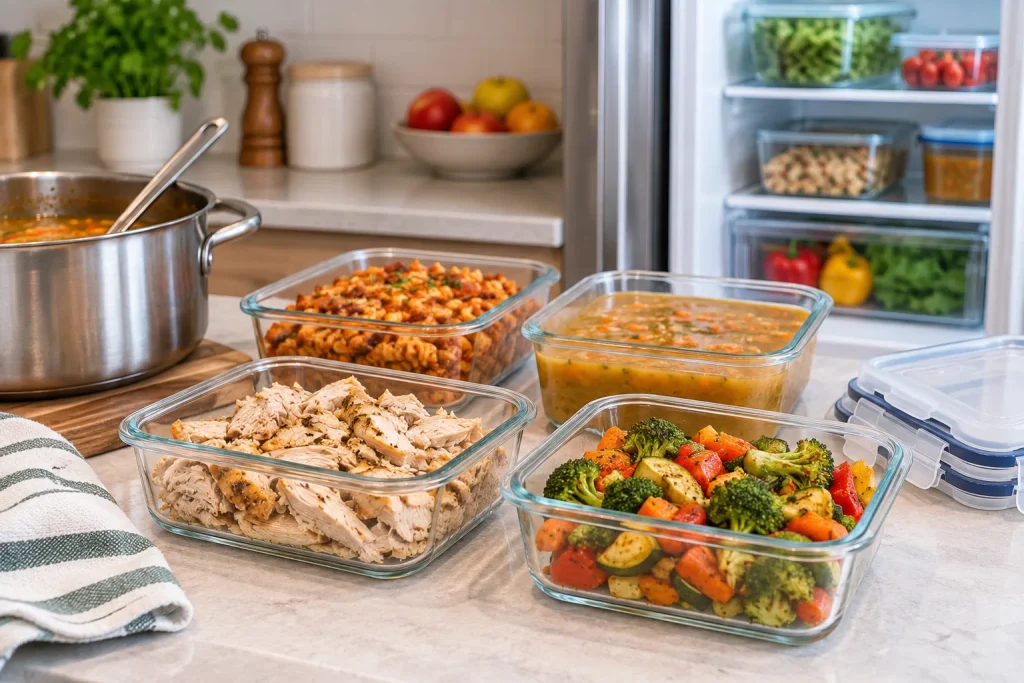
Large amounts of hot food cool more efficiently when divided into smaller portions and placed into shallow containers. Both Health Canada and USDA recommend this approach.
You do not need to leave a pot of food sitting on the counter until it becomes completely cold.
What about Australia’s 2-hour / 4-hour rule?
Australia uses a useful system for potentially hazardous food that has been between 5°C and 60°C.
If the total time is:
| Time out of refrigeration | What to do |
|---|---|
| Less than 2 hours | Use it or refrigerate it again |
| 2 to 4 hours | Use it immediately, but do not refrigerate it again |
| More than 4 hours | Discard it |
The time is cumulative. If food is out for an hour, refrigerated again, then sits out another hour later, those periods count together.
That last detail is easy to overlook. The clock does not develop amnesia every time the casserole goes back into the fridge.
What temperature should your refrigerator be?
Storage times only make sense when the refrigerator is actually cold enough.
Health Canada recommends 4°C / 40°F or lower. USDA also uses 40°F / 4°C or below. The UK Food Standards Agency recommends a refrigerator between 0°C and 5°C, as does Ireland. New Zealand recommends 2°C to 5°C, while Australian guidance generally uses 5°C or colder for potentially hazardous foods.
A small refrigerator thermometer is useful because the numbered dial inside a fridge does not necessarily tell you the actual temperature.
Also avoid packing the refrigerator so tightly that cold air cannot circulate properly.
Are all leftovers good for the same number of days?
No.
“Leftovers” can mean roast chicken, vegetable soup, seafood pasta, fried rice, gravy, pizza or potato salad. Those foods do not all behave exactly the same way.
For example, Health Canada’s storage chart gives:
| Leftover food | Canadian refrigerator guidance |
|---|---|
| Cooked meat, stews, egg or vegetable dishes | 3 to 4 days |
| Cooked poultry and fish | 3 to 4 days |
| Meat broth and gravy | 3 to 4 days |
| Soup | 2 to 3 days |
In Australia, NSW Food Authority recommends most leftovers within 3 days but specifically shortens cooked rice and pasta to 2 days.
New Zealand also gives rice-based leftovers a 2-day limit because uncooked rice can contain bacterial spores that survive cooking and may later produce toxins if the cooked rice is handled incorrectly.
So when specific guidance exists for the food you have, use that instead of applying a blanket number to everything in the fridge.
How long are meat and chicken leftovers good for?
In Canada, cooked meat, stews and cooked poultry are generally listed at 3 to 4 days when properly refrigerated. USDA also recommends 3 to 4 days for most cooked meat and poultry leftovers.
For chicken specifically, our separate guide How Long Does Cooked Chicken Last in the Fridge? goes into the country-by-country differences in more detail.
How long do soup and stew leftovers last?
The answer again depends on the country.
Health Canada’s detailed storage chart gives 2 to 3 days for soup, while cooked meat and stews are listed at 3 to 4 days. USDA generally gives soups and stews 3 to 4 days.
This is a good example of why Kitchen Answers should not simply publish one American storage number and present it as a worldwide rule.
Can you eat leftovers on day 4?
Possibly, depending on the food and your region.
In the United States, day four is normally the upper end of USDA’s 3 to 4 day recommendation for most cooked leftovers. Some Canadian food-specific guidance also goes to 3 to 4 days.
However, day four is beyond the UK’s 48-hour recommendation, Ireland’s 2 to 3 day guidance, Australia’s general 3-day recommendation, and Health Canada’s more conservative general leftover advice of 2 to 3 days.
So “four days is always fine” is too broad.
Are leftovers good after 5 days?
Five days is beyond the normal general leftover recommendations from the food-safety authorities covered here.
Even in the U.S., where most leftovers are given 3 to 4 days, day five is outside the recommended refrigerator period.
If you know you will not use your leftovers within the recommended period, freeze them earlier rather than trying to squeeze another day or two out of the refrigerator.
What about 7-day-old leftovers?
A full week is well beyond the general refrigerated leftover guidance discussed in this article.
Do not use smell or appearance to justify keeping week-old perishable leftovers.
At that point, the sensible kitchen decision is disposal, not an archaeological investigation.
Can you tell if leftovers are safe by smelling them?
No.
Spoilage can certainly make food smell bad, become slimy or develop mould. If that happens, throw the food away.
The problem is that food can also contain harmful microorganisms without developing an obvious smell, taste or appearance change.
Health Canada specifically warns not to rely on your nose, eyes or taste buds to judge food safety.
A food that smells bad should not be eaten, but a food that smells fine has not passed a food-safety test.
Never taste questionable leftovers to decide whether they are safe.
Can you freeze leftovers?
Yes. Freezing is one of the easiest ways to avoid wasting food you will not finish in time.
USDA says refrigerated leftovers can generally be frozen for 3 to 4 months for best quality. Food kept continuously frozen at 0°F / -18°C can remain safe longer, although quality eventually declines.
Health Canada’s freezer recommendations vary by food. For example:
- cooked meat, stews, egg and vegetable dishes: 2 to 3 months
- cooked poultry and fish: 4 to 6 months
- meat broth and gravy: 4 to 6 months
- soup: about 4 months
For best results, freeze food while it is still comfortably within its refrigerator storage period rather than waiting until the last possible day.
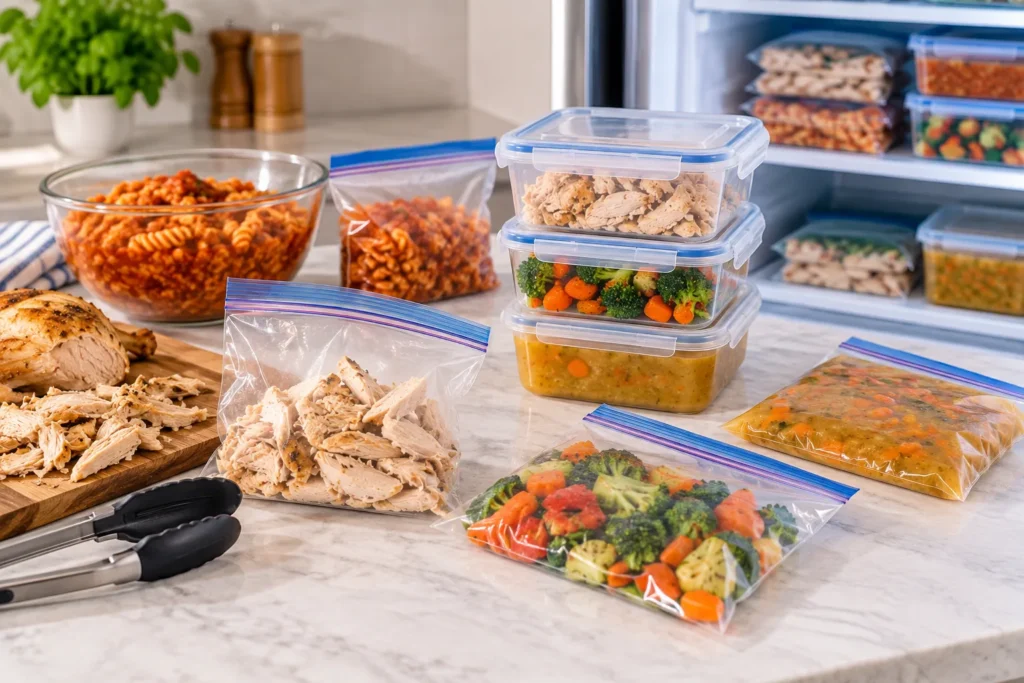
Divide it into meal-sized portions and use airtight freezer containers or freezer bags.
Does freezing reset old leftovers?
No.
Freezing slows microbial activity, but it does not turn poorly handled or already questionable food back into fresh food.
If leftovers have already spent too long at room temperature or are beyond the recommended refrigerator period, putting them into the freezer is not a rescue plan.
Freeze leftovers while they are still within their recommended storage period.
How should you thaw frozen leftovers?
The refrigerator is one of the safest methods.
USDA also recognizes cold-water and microwave thawing for leftovers, with additional handling requirements. Health Canada recommends thawing leftovers in the refrigerator or microwave rather than at room temperature.
New Zealand likewise advises thawing in the refrigerator or microwave rather than leaving frozen meals on the kitchen bench.
How hot should leftovers be when reheated?
In Canada, Health Canada recommends reheating leftovers to an internal temperature of 74°C / 165°F. USDA also recommends 165°F.
The UK advises reheating food until it is steaming hot throughout. Ireland recommends at least 70°C, while New Zealand advises reheating leftovers until piping hot, over 75°C.
Microwave reheating deserves extra attention because food can develop hot and cold spots. Stirring, rotating and allowing suitable standing time can help the heat distribute more evenly.
Can leftovers be reheated more than once?
Several food-safety authorities recommend reheating leftovers only once.
The UK Food Standards Agency says leftovers should only be reheated once. Ireland gives the same advice, and New Zealand also recommends not reheating leftovers more than once. Health Canada’s general food-safety guidance says you should not normally reheat the same leftovers more than once.
A practical way to handle this is to reheat only the portion you intend to eat rather than warming the entire container repeatedly.
What is the best way to store leftovers?
A few habits make leftover storage much easier:
- Refrigerate promptly. Aim to get perishable leftovers refrigerated within about 2 hours.
- Use shallow containers. Smaller portions cool faster than one large deep pot.
- Cover the food. Use clean containers or suitable wrapping.
- Keep the refrigerator cold. Follow your country’s recommended refrigerator temperature.
- Label the date. Do not rely on memory.
- Freeze what you will not use soon. Do this before the refrigerator storage period runs out.
- Keep raw and cooked foods separate. Raw meat should not be able to drip onto ready-to-eat leftovers.
These are simple habits, but they remove most of the guesswork.
Frequently Asked Questions
How long are leftovers good for in the fridge?
The answer varies by country and food. USDA generally recommends 3 to 4 days. Health Canada’s general guidance is 2 to 3 days, although many specific cooked dishes are listed at 3 to 4 days. The UK recommends 48 hours, Ireland 2 to 3 days, and Australia generally 3 days.
Is 3-day-old food okay to eat?
Three days falls within the recommended period for many leftovers in several countries, assuming the food was cooked properly, refrigerated promptly and kept at the correct temperature. Specific foods and regional guidance can be shorter.
Are 4-day-old leftovers okay?
In the U.S., four days is generally the upper end of USDA guidance for most cooked leftovers. Four days is longer than the general recommendations in several other countries, so check the guidance that applies to your region and food.
Can I eat leftovers after 5 days?
Five days is beyond the general refrigerated storage guidance from the authorities covered here. Discard the food rather than relying on smell or appearance.
How long can restaurant leftovers stay in the fridge?
Treat restaurant leftovers as perishable cooked food and refrigerate them promptly. In the U.S., USDA guidance for most leftovers is 3 to 4 days. Other countries use shorter general periods, so follow your regional recommendation.
What if I cannot remember when the leftovers were made?
If you cannot determine how old refrigerated perishable leftovers are, the cautious choice is to discard them. Dating containers when they go into the fridge is a much easier system than trying to reconstruct dinner history several days later.
Check the Storage Time for What You Have
“Leftovers” covers a lot of different foods, and some need shorter storage times than others.
The Kitchen Answers Food Storage Time Finder lets you search for foods such as cooked chicken, rice, spaghetti sauce, milk and other common refrigerator items, then choose your region for more relevant guidance.
Related Kitchen Answers
About the countries in this guide
Kitchen Answers checks official guidance from six countries: the United States, Canada, the United Kingdom, Ireland, Australia and New Zealand. We chose these because each one publishes clear, detailed food safety advice in English that we can read and check directly, and because most of our readers live there.
If your country isn’t listed, that’s not because its guidance doesn’t matter. We just haven’t been able to check it ourselves yet, and we won’t guess. Your national or local food safety authority is the best place to check. If you can’t find local advice, the World Health Organization’s Five Keys to Safer Food are a reliable starting point anywhere in the world, and the Food Storage Time Finder has an International (WHO) option for the same reason. If you live somewhere hot, food left out spoils faster, so get it into the fridge sooner.
You can read more about how we check our sources on our About page.
Sources
The important storage and safety guidance in this article comes from official national and international food-safety authorities.
Health Canada: Food Safety Tips for Leftovers
Health Canada: Safe Food Storage Chart
USDA: Leftovers and Food Safety
USDA: Food Safety Basics and Cold Storage Chart
UK Food Standards Agency: Cooking and Using Leftovers
Food Safety Authority of Ireland: Storing Food Safely