
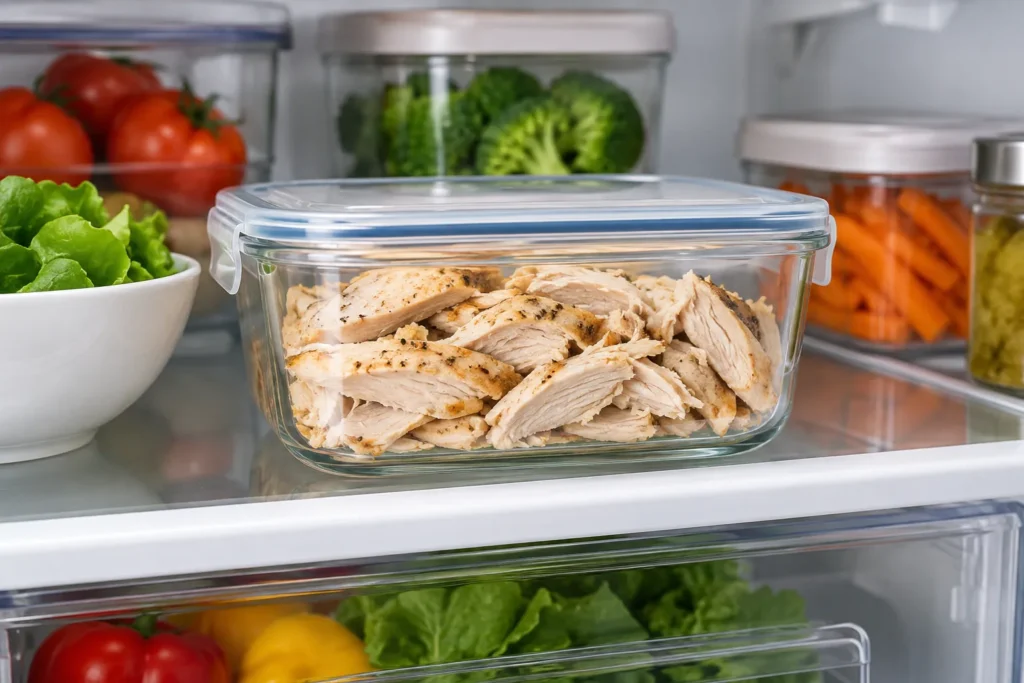
How long does cooked chicken last in the fridge? In Canada and the United States, properly refrigerated cooked chicken is generally recommended for 3 to 4 days. The answer is not exactly the same everywhere, though. The UK recommends eating leftovers within 48 hours, Ireland gives 2 to 3 days, Australia recommends up to 3 days, and New Zealand uses different times depending on whether the leftovers will be eaten cold or reheated.
The storage time also assumes the chicken was refrigerated promptly and kept cold enough. A container that sat on the kitchen counter for half the evening has a different story to tell.
Quick answer: how long does cooked chicken last in the fridge by region?
| Region | Recommended refrigerated storage |
|---|---|
| Canada | 3 to 4 days for cooked poultry |
| United States | 3 to 4 days |
| United Kingdom | Eat within 48 hours or freeze |
| Ireland | 2 to 3 days |
| Australia | Up to 3 days |
| New Zealand | Up to 4 days if reheated hot; 2 days if normally eaten cold |
| International / WHO guidance | General leftovers should not normally be refrigerated longer than 3 days |
Health Canada’s food-specific storage chart gives cooked poultry 3 to 4 days at 4°C / 40°F or below. USDA gives the same 3 to 4 day range at 40°F / 4°C or below. WHO’s Five Keys manual uses a more conservative general recommendation of no more than 3 days for refrigerated leftovers.
We’ve checked guidance for Canada, the US, the UK, Ireland, Australia and New Zealand directly. If yours isn’t listed, see how we research food storage guidance.
If you want an answer based on where you live and the food you actually have, use the Food Storage Time Finder.
How long does cooked chicken last in the fridge in Canada?
For Canada, 3 to 4 days is the best food-specific answer for cooked chicken.
Health Canada’s Safe Food Storage chart lists cooked poultry at 3 to 4 days in a refrigerator at 4°C / 40°F or colder, with a freezer quality recommendation of 4 to 6 months. The Canadian Food Inspection Agency also advises using refrigerated leftover cooked chicken within 3 to 4 days.
You may notice that some other Health Canada pages recommend eating leftovers within 2 to 3 days or 2 to 4 days. That is not necessarily a contradiction. Those are broader leftover recommendations, while the storage chart gives a specific range for cooked poultry. If you prefer the more cautious approach, using the chicken within 2 to 3 days is perfectly reasonable.
When does the storage clock start?
Start counting from the day the chicken was cooked.
If you cook chicken on Monday and refrigerate it promptly, then under Canadian and U.S. guidance the normal 3 to 4 day window takes you roughly through Thursday or Friday.
That does not mean Friday night is automatically safe in every situation. The recommendation assumes the chicken was handled properly, cooled promptly and continuously refrigerated at the correct temperature.
A small label on the container with the cooking date can prevent a surprising amount of refrigerator detective work later.
How quickly should cooked chicken be refrigerated?
Cooked chicken should generally be refrigerated or frozen within 2 hours.
Health Canada advises refrigerating or freezing poultry leftovers within two hours. USDA uses the same two-hour rule, but shortens it to one hour if the surrounding temperature is above 90°F / 32°C. The UK and New Zealand also advise getting leftovers into the refrigerator within about two hours.
Australia handles this with its 2-hour / 4-hour rule. Potentially hazardous food that has spent less than two hours between 5°C and 60°C can generally go back into the fridge. Between two and four hours, it should be used immediately rather than refrigerated again. After four hours, it should be discarded.
That time is cumulative. Taking chicken out, putting it back, then taking it out again does not magically restart the clock.
What temperature should the fridge be?
In Canada and the United States, keep the refrigerator at 4°C / 40°F or below.
Australia recommends keeping potentially hazardous foods at 5°C or colder. Ireland advises a refrigerator temperature between 0°C and 5°C, while WHO recommends refrigerating cooked and perishable foods promptly, preferably below 5°C.
If your refrigerator runs warmer than the recommended range, the normal storage times should not be assumed to apply.
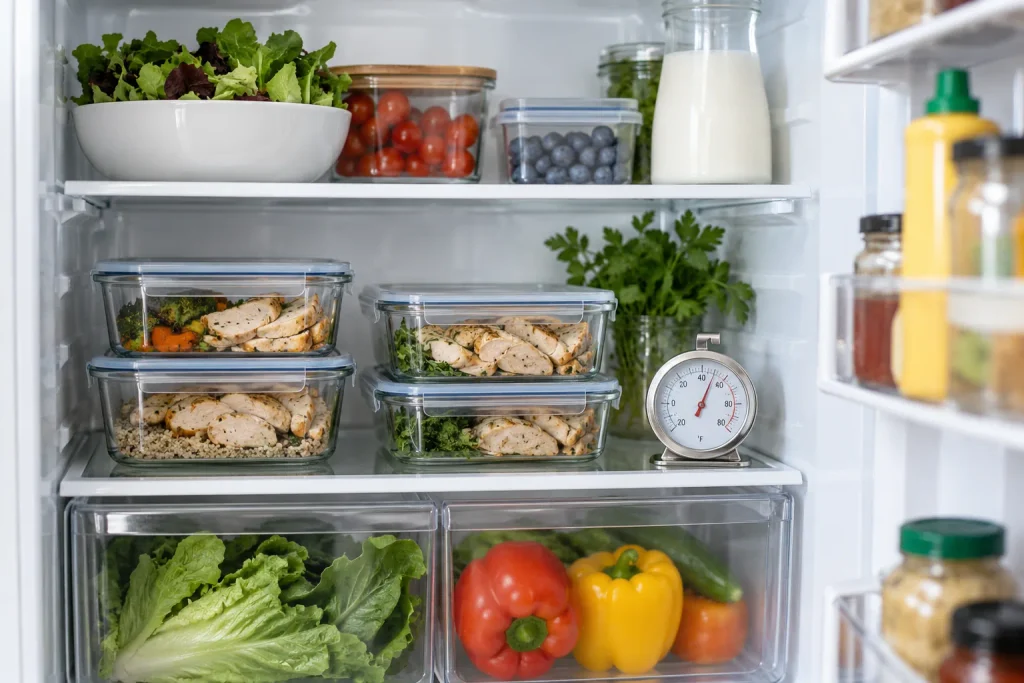
A fridge thermometer is inexpensive and much more reliable than turning the temperature dial to a mysterious number like “3” and hoping for the best.
Does rotisserie chicken last the same amount of time?
Generally, yes.
Store-bought rotisserie chicken should be treated like other cooked chicken once you bring it home. USDA specifically recommends refrigerating ready-prepared rotisserie or fast-food chicken within two hours and eating it within 3 to 4 days.
The same basic storage guidance applies to most plain cooked chicken, including roasted chicken, baked chicken breasts, thighs, shredded chicken and fried chicken.
If the chicken came in commercial packaging with a shorter storage instruction, follow the package.
How long does fried chicken last in the fridge?
USDA lists fried chicken at 3 to 4 days refrigerated at 40°F / 4°C or below.
The coating does not give fried chicken extra refrigerator life. It may change texture long before the safety window ends, especially once the crust starts absorbing moisture.
How long does shredded chicken last?
Plain shredded cooked chicken follows the same basic storage guidance as other cooked chicken.
In Canada and the U.S., that means about 3 to 4 days under proper refrigeration. If the shredded chicken is mixed into a dish containing other ingredients, the storage guidance for the finished dish may be different.
Chicken salad is a good example. Its storage time can depend on the other ingredients and whether it was homemade, deli-prepared or commercially packaged.
Is cooked chicken still okay on day 4?
That depends on your region.
In Canada and the United States, day four is the upper end of the usual 3 to 4 day recommendation. In the UK, four-day-old leftovers are already beyond the recommended 48-hour window. Ireland’s recommendation is 2 to 3 days, while Australia’s general leftover guidance is within 3 days.
So a universal statement such as “chicken is fine for four days” is too broad. Location and handling matter.
If you know you will not eat it within the recommended refrigerator window, freezing it earlier is a better plan.
Can you eat cooked chicken after 5 days?
Five-day-old refrigerated chicken is beyond the recommended storage period used by Canada, the U.S., UK, Ireland and Australia.
I would discard it rather than try to stretch the storage recommendation another day.
Food-safety limits are not like parking meters where you can hope nobody notices you went a little over.
Can you tell if cooked chicken has gone bad by smelling it?
Spoiled chicken can develop an unpleasant smell, unusual texture, mould or other obvious changes. Those are good reasons to throw it away.
The trouble is that the reverse is not reliable. Chicken that looks and smells normal is not automatically safe.
Harmful bacteria do not always produce an obvious smell, taste or appearance change. Food-safety agencies therefore recommend relying on proper handling, temperatures and storage times rather than using a sniff test to extend the recommended period. WHO likewise notes that refrigeration slows microorganism growth but does not stop it completely.
Never taste questionable chicken to decide whether it is safe.
Can you freeze cooked chicken?
Yes. Cooked chicken freezes well, especially when you portion it before freezing.
Health Canada lists 4 to 6 months as the recommended freezer period for cooked poultry at -18°C / 0°F or colder. USDA recommends about 4 months for best quality for plain leftover cooked chicken.
There is an important distinction here. Refrigerator times are primarily food-safety recommendations. Freezer times are often about maintaining quality.
USDA states that chicken kept continuously frozen at 0°F / -18°C remains safe indefinitely, although taste and texture decline over time.
For the best results, freeze chicken in meal-sized portions using airtight freezer containers or bags. Remove as much excess air as practical.

What is the best way to store leftover chicken?
Let the chicken stop steaming, then get it into the refrigerator promptly rather than leaving it out to cool for hours.
Shallow containers are useful because they allow food to cool more quickly. Health Canada recommends dividing leftovers into shallow containers and refrigerating them promptly.
Keep the container covered once the food has cooled. Dating the container is also worthwhile, particularly if your refrigerator tends to collect mystery leftovers.
For a whole roast chicken or turkey, removing the meat from the carcass and dividing it into smaller portions helps it cool more quickly.
How should frozen cooked chicken be thawed?
The refrigerator is the simplest method.
Move the portion you need from the freezer to the fridge and allow it to thaw while staying cold.
Health Canada recommends thawing frozen leftovers in the refrigerator or microwave rather than at room temperature. WHO also advises against thawing frozen food on the counter.
If you use the microwave to thaw cooked chicken, reheat and eat it promptly.
How hot should reheated chicken be?
In Canada, leftovers should be reheated to an internal temperature of at least 74°C / 165°F. USDA also recommends reheating leftovers to 165°F.
The wording differs slightly elsewhere. The UK Food Standards Agency says leftovers should be reheated until steaming hot throughout and recommends reheating leftovers only once. Ireland advises reheating leftovers to 70°C or higher. New Zealand recommends reheating hot leftovers until piping hot, over 75°C.
Avoid repeatedly cooling and reheating the same container. Take out the portion you intend to eat and leave the rest refrigerated.
Can cooked chicken be eaten cold?
Yes, properly cooked chicken can be eaten cold if it was cooled and refrigerated correctly and is still within the applicable storage period.
Cold chicken in a sandwich or salad does not need to be reheated just because it came from the refrigerator.
However, New Zealand’s guidance makes an interesting distinction. Cooked leftovers normally eaten cold should be eaten within 2 days, while leftovers that will be reheated hot can be refrigerated for up to 4 days.
That is another reason our Food Storage Time Finder asks for region rather than applying one storage number worldwide.
Frequently Asked Questions
Is 4-day-old cooked chicken safe to eat?
Under Canadian and U.S. guidance, day four is the end of the normal 3 to 4 day refrigerated storage period. Other countries use shorter recommendations, so check the guidance for your region. Proper handling and refrigeration are still required.
Is 7-day-old cooked chicken safe?
Seven days is well beyond the refrigerated storage guidance covered in this article. Discard it rather than relying on smell or appearance.
How long does cooked chicken breast last in the fridge?
Cooked chicken breast generally follows the same storage guidance as other plain cooked chicken. In Canada and the United States, that is about 3 to 4 days when properly refrigerated.
How long does rotisserie chicken last after you buy it?
USDA recommends eating refrigerated rotisserie chicken within 3 to 4 days, assuming it was refrigerated within two hours of purchase.
Can you freeze cooked chicken after 3 days in the fridge?
If the chicken has been handled correctly and is still within the recommended refrigerator storage period, it can be frozen rather than discarded. Freezing earlier usually gives better quality.
What if I do not remember when the chicken was cooked?
If you cannot reliably determine how long cooked chicken has been in the refrigerator, the safest choice is to discard it. Next time, add the date to the container before it disappears behind the pickle jar.
Check Your Food Storage Time
Cooked chicken is only one of many foods with storage times that vary by region.
The Kitchen Answers Food Storage Time Finder lets you search for chicken, milk, rice, spaghetti sauce, leftovers and other common foods, then choose your region for more relevant refrigerator and freezer guidance.
You can also browse the Food Storage section as more individual storage guides are added.
More food storage information: see the Food Storage section.
About the countries in this guide
Kitchen Answers checks official guidance from six countries: the United States, Canada, the United Kingdom, Ireland, Australia and New Zealand. We chose these because each one publishes clear, detailed food safety advice in English that we can read and check directly, and because most of our readers live there.
If your country isn’t listed, that’s not because its guidance doesn’t matter. We just haven’t been able to check it ourselves yet, and we won’t guess. Your national or local food safety authority is the best place to check. If you can’t find local advice, the World Health Organization’s Five Keys to Safer Food are a reliable starting point anywhere in the world, and the Food Storage Time Finder has an International (WHO) option for the same reason. If you live somewhere hot, food left out spoils faster, so get it into the fridge sooner.
You can read more about how we check our sources on our About page.
Sources
This article was researched using current guidance from Health Canada, the Canadian Food Inspection Agency, USDA Food Safety and Inspection Service, the UK Food Standards Agency, Food Safety Authority of Ireland, Food Standards Australia New Zealand, NSW Food Authority, New Zealand Food Safety and the World Health Organization.
Health Canada: Safe Food Storage
Canadian Food Inspection Agency: Chicken and Salmonella Safety
USDA: How Long Can You Keep Cooked Chicken?
USDA: Chicken From Farm to Table
UK Food Standards Agency: Using Your Leftovers
Food Safety Authority of Ireland: Cooking and Reheating