
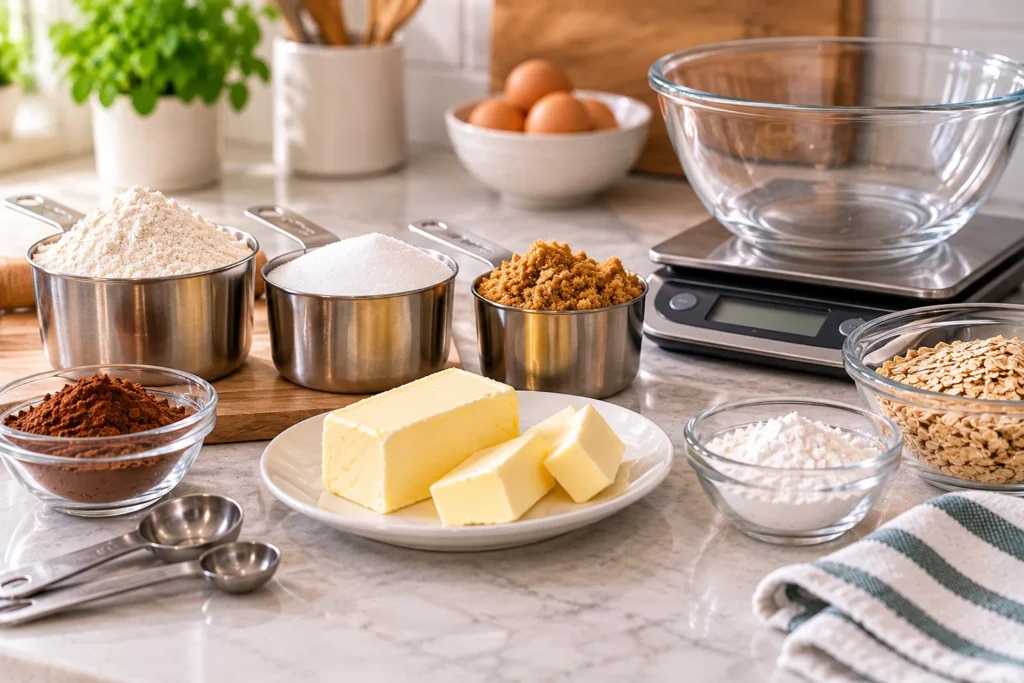
Converting cups to grams is not as simple as using one number. A cup measures volume, while grams measure weight, so 1 cup of flour does not weigh the same as 1 cup of sugar, butter or oats.
For example, King Arthur Baking lists 1 cup of all-purpose flour at 120 grams, 1 cup of granulated sugar at 198 grams, and 1 cup of packed brown sugar at 213 grams. Butter comes to about 226 grams per cup based on its 113-gram half-cup measurement.
That is why a useful cups-to-grams conversion must always answer one more question:
A cup of what?
Quick Cups to Grams Chart
The chart below uses practical ingredient weights based primarily on King Arthur Baking’s ingredient weight references. These are suitable starting points for everyday cooking and baking, but ingredient weights can vary slightly by brand and measuring method.
| Ingredient | 1 cup | 1/2 cup | 1/4 cup |
|---|---|---|---|
| All-purpose flour | 120 g | 60 g | 30 g |
| Granulated sugar | 198 g | 99 g | 50 g |
| Brown sugar, packed | 213 g | 107 g | 53 g |
| Confectioners’ sugar | 113 g | 57 g | 28 g |
| Butter | about 226 g | 113 g | 57 g |
| Unsweetened cocoa powder | about 84 g | 42 g | 21 g |
| Old-fashioned or quick oats | 89 g | about 45 g | about 22 g |
| Almond flour | 96 g | 48 g | 24 g |
| Cornstarch | about 112 g | 56 g | 28 g |
If your ingredient is not listed here, use the Kitchen Answers Kitchen Measurement Converter. It can convert ingredient-specific measurements instead of assuming every cup has the same weight.
How to Convert Cups to Grams
To convert cups to grams, you need to know how many grams one cup of that particular ingredient weighs.
The basic calculation is:
Number of cups × grams per cup = total grams
If 1 cup of all-purpose flour weighs 120 grams:
2 cups × 120 g = 240 g
So 2 cups of flour is approximately 240 grams.
For 1 1/2 cups:
1.5 × 120 g = 180 g
For 3/4 cup:
0.75 × 120 g = 90 g
The arithmetic is easy. Finding the correct grams-per-cup value is the important part.
Why Isn’t 1 Cup Always the Same Number of Grams?
Because cups and grams measure two different things.
A cup tells you how much space an ingredient fills. Grams tell you how much it weighs.
Think about filling two identical measuring cups, one with flour and one with granulated sugar. The cups have the same volume, but the sugar packs much more material into that space.
Honey is denser still.
The same idea explains why you cannot reliably use a conversion such as:
1 cup = 240 grams
That might be reasonably close for some liquids, but it is nowhere near correct for flour.
A cup of all-purpose flour at 120 grams would end up with twice as much flour if you blindly converted it to 240 grams. Your cake would probably notice.
How Many Grams Is 1 Cup of Flour?
For Kitchen Answers conversions, 1 cup of all-purpose flour is approximately 120 grams when using the King Arthur Baking reference.
That gives you:
| Flour | Grams |
|---|---|
| 1/4 cup | 30 g |
| 1/3 cup | 40 g |
| 1/2 cup | 60 g |
| 2/3 cup | 80 g |
| 3/4 cup | 90 g |
| 1 cup | 120 g |
| 1 1/2 cups | 180 g |
| 2 cups | 240 g |
| 3 cups | 360 g |
You may see another baking source list a cup of flour at 125 grams or even somewhat more. That does not necessarily mean one chart is wrong.
Flour is particularly sensitive to how it is measured.
Why Does the Weight of a Cup of Flour Vary?
Flour can settle, compact and trap air.
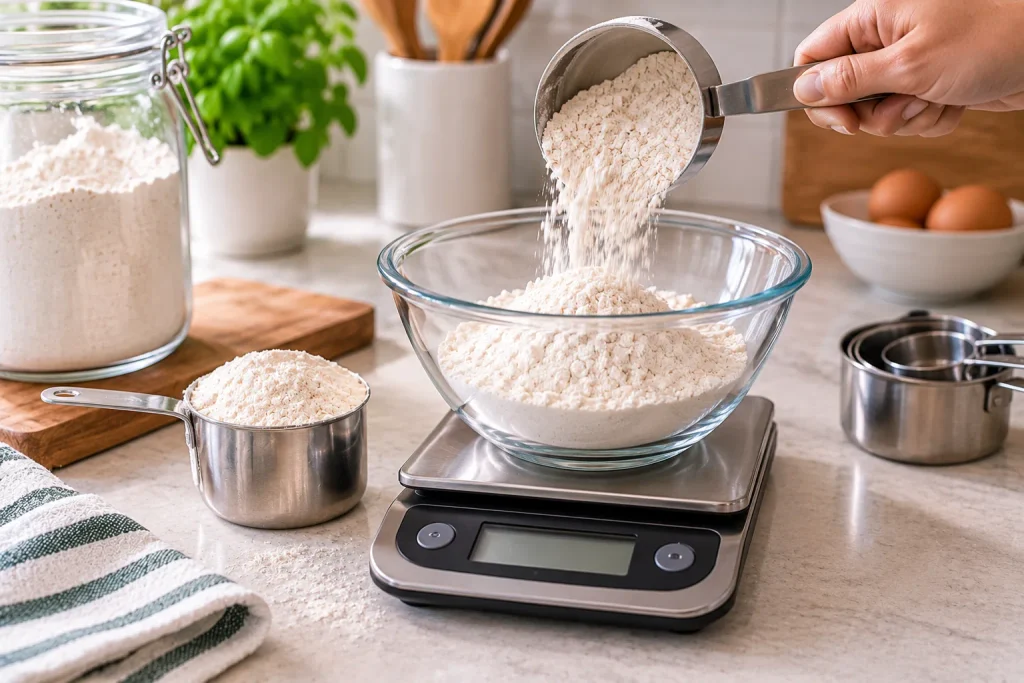
If you scoop a measuring cup directly into a bag of flour, you can pack considerably more flour into the cup than if you spoon the flour gently into the cup and level the top.
King Arthur Baking recommends weighing ingredients for the most consistent baking results and uses 120 grams for a cup of its all-purpose flour.
NIST also recommends that, when converting a traditional American recipe accurately, one practical method is to measure the ingredient using the original measuring method and then weigh the result on a kitchen scale.
This is one reason a digital scale is especially useful for bread, cakes, cookies and pastry.
How Many Grams Is 1 Cup of Sugar?
It depends on the sugar.
Granulated sugar
King Arthur Baking lists:
1 cup granulated sugar = 198 grams.
For everyday kitchen use, you will often see this rounded to 200 grams.
That gives an easy working guide:
- 1/4 cup = about 50 g
- 1/2 cup = about 100 g
- 3/4 cup = about 149 to 150 g
- 1 cup = about 198 to 200 g
Brown sugar
Packed brown sugar is heavier:
1 cup packed brown sugar = 213 grams.
Brown sugar is normally packed into the measuring cup because that is how many volume-based recipes define the measurement.
Confectioners’ or icing sugar
Confectioners’ sugar is much lighter:
1 cup unsifted confectioners’ sugar = 113 grams.
This is a good example of why simply searching “1 cup sugar in grams” can give you the wrong answer. The type of sugar matters.
How Many Grams Is 1 Cup of Butter?
A half cup of butter is listed at 113 grams, which makes a full cup approximately 226 grams. In everyday North American recipes this is often rounded to about 227 grams.
A useful butter guide is:
| Butter | Grams |
|---|---|
| 1/4 cup | about 57 g |
| 1/3 cup | about 75 g |
| 1/2 cup | 113 g |
| 3/4 cup | about 170 g |
| 1 cup | about 226 g |
Butter is easier to convert than flour because it does not change volume nearly as much depending on how enthusiastically someone attacks it with a measuring cup.
Common Baking Ingredients in Cups and Grams
Here are a few more useful reference amounts:
Cocoa powder
King Arthur lists 1/2 cup unsweetened cocoa at 42 grams, giving approximately 84 grams per cup.
Almond flour
1 cup almond flour = 96 grams.
That is quite different from wheat flour even though both are called flour.
Cornstarch
King Arthur lists 1/4 cup cornstarch at 28 grams, which works out to about 112 grams per cup.
Rolled oats
Old-fashioned or quick-cooking oats are listed at 89 grams per cup.
These differences are exactly why Kitchen Answers uses ingredient-specific conversions rather than a single generic cup-to-gram multiplier.
Is a US Cup the Same Size as a Metric Cup?
Not quite.
NIST’s practical cooking equivalencies use approximately 240 mL for 1 U.S. customary cup.
A metric cup used in Australian cooking is 250 mL. Australian public-health cooking materials explicitly use a 250 mL metric cup.
That difference is only about 4 percent, so it may make little practical difference in a forgiving soup or casserole.
Baking can be less forgiving because several small measurement differences can accumulate.
Practical cup-size guide
| Recipe type | Cup size to expect |
|---|---|
| U.S. recipe | about 240 mL |
| Australian metric recipe | 250 mL |
| New Zealand metric recipe | generally 250 mL |
| Canadian metric recipe | often 250 mL |
| Older British or imperial recipe | check the original measurement system |
NIST specifically cautions that customary measures such as cups, pints, quarts and gallons can mean different things in different countries.
If you know where the recipe came from, select the appropriate region in the Kitchen Measurement Converter rather than assuming every cup is identical.
Does the Cup Size Change the Grams?
Yes.
If a metric cup holds 250 mL and a U.S. cooking cup is approximately 240 mL, the metric cup holds slightly more of the same ingredient.
That means the gram weight also increases.
For rough cooking, this difference may not matter much. For precision baking, it is worth paying attention to the recipe’s country of origin.
The safest approach when a recipe already provides grams is simple:
Use the grams.
Do not convert the grams back into cups unless you have to. You would be converting the more precise measurement into the less precise one.
Why Is Weighing Better for Baking?
A kitchen scale removes several sources of variation at once.
You do not have to worry about:
- whether flour was scooped or spooned
- how firmly brown sugar was packed
- whether the measuring cup was completely level
- whether your cup standard matches the recipe
- whether an ingredient settled during storage
King Arthur Baking recommends weighing ingredients with a digital scale for best results.
NIST also notes that ingredient density matters when cooking by mass and recommends weighing measured ingredients when accurate conversion of traditional recipes is needed.
For a stew, a few grams of flour one way or another may not change dinner very much.
For bread dough, pastry or a delicate cake, those grams can matter.
How to Measure Dry Ingredients When You Don’t Have a Scale
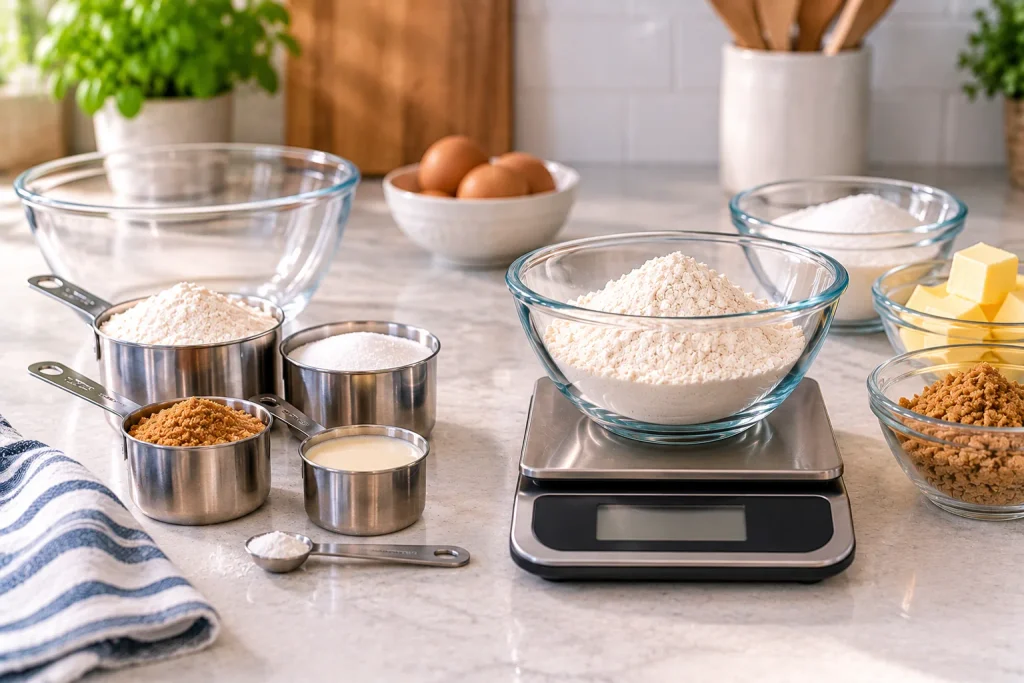
If your recipe gives cups and you do not have a kitchen scale, you can still get good results.
For ingredients such as flour:
- Stir or fluff the flour gently.
- Spoon it into the dry measuring cup.
- Do not press it down unless the recipe specifically tells you to.
- Level the top with the straight edge of a knife or similar utensil.
NIST recommends striking off excess dry ingredients when using dry measuring cups.
For brown sugar, follow the recipe’s instruction about packing.
For liquids, use a liquid measuring cup on a level surface and read the measurement at eye level.
What If a Recipe Uses Cups but You Want Grams?
You have three good options.
The quickest is to use the Kitchen Measurement Converter, select the ingredient, enter the cup amount and choose the appropriate measurement region.
Convert cups to grams with the Kitchen Measurement Converter
You can also use a trusted ingredient weight chart such as King Arthur Baking’s reference.
The third option is useful when you make the same recipe regularly: measure the ingredient the way the original recipe instructs, weigh it once, and write the gram amount on your recipe.
Next time, the conversion is already done.
Kitchen Answers Tip
When converting an entire baking recipe from cups to grams, convert each ingredient separately.
Do not use one cups-to-grams formula for the whole recipe.
Two cups of flour, one cup of sugar and half a cup of butter are three different calculations because the ingredients have different densities.
If you are also increasing or decreasing the number of servings, use the Recipe Scaling Calculator after you establish the correct ingredient quantities.
Frequently Asked Questions
Is 1 cup equal to 240 grams?
No. A cup is a volume measurement and grams are a weight measurement. About 240 grams may be a useful approximation for water-like liquids in a 240 mL cup, but flour, sugar, butter and other ingredients all have different weights.
How many grams is 1 cup of flour?
Using the King Arthur Baking reference, 1 cup of all-purpose flour is 120 grams. Other references may use slightly different amounts because flour weight depends on the flour and how it is measured.
How many grams is 1 cup of sugar?
One cup of granulated sugar is approximately 198 grams, commonly rounded to about 200 grams. Packed brown sugar is heavier at about 213 grams per cup.
How many grams is 1 cup of butter?
One cup of butter is approximately 226 to 227 grams. Half a cup is about 113 grams.
How many grams is half a cup?
There is no single answer. Half a cup of flour is about 60 grams, half a cup of granulated sugar about 99 grams, and half a cup of butter about 113 grams.
Is a Canadian cup the same as a US cup?
Canadian recipes may use metric measurements, including a 250 mL cup, while traditional U.S. cooking measurements use a cup of approximately 240 mL. When precision matters, check the source of the recipe rather than assuming the cup size.
Should I use cups or grams for baking?
If both are provided, grams are usually the better choice for precision and repeatability. A kitchen scale avoids much of the variation caused by scooping, packing and cup size.
Convert Any Ingredient from Cups to Grams
A reference chart is handy for common ingredients, but there are far too many foods to fit sensibly onto one page.
Use the Kitchen Answers Kitchen Measurement Converter when you need to convert a specific ingredient or work with a recipe from another country.
You can also browse more measurement guides in Kitchen Conversions as we build out the conversion library.
Recipe Scaling Calculator Need to make a recipe for more—or fewer—people?
Sources
The main ingredient weights in this article are based on King Arthur Baking’s tested Ingredient Weight Chart.
NIST guidance was used for U.S. cooking measurement equivalents, measuring practices and the caution that customary cooking measures can vary between countries.
Australian government-supported cooking materials were checked for the 250 mL metric cup used in Australian recipes.
King Arthur Baking Ingredient Weight Chart