
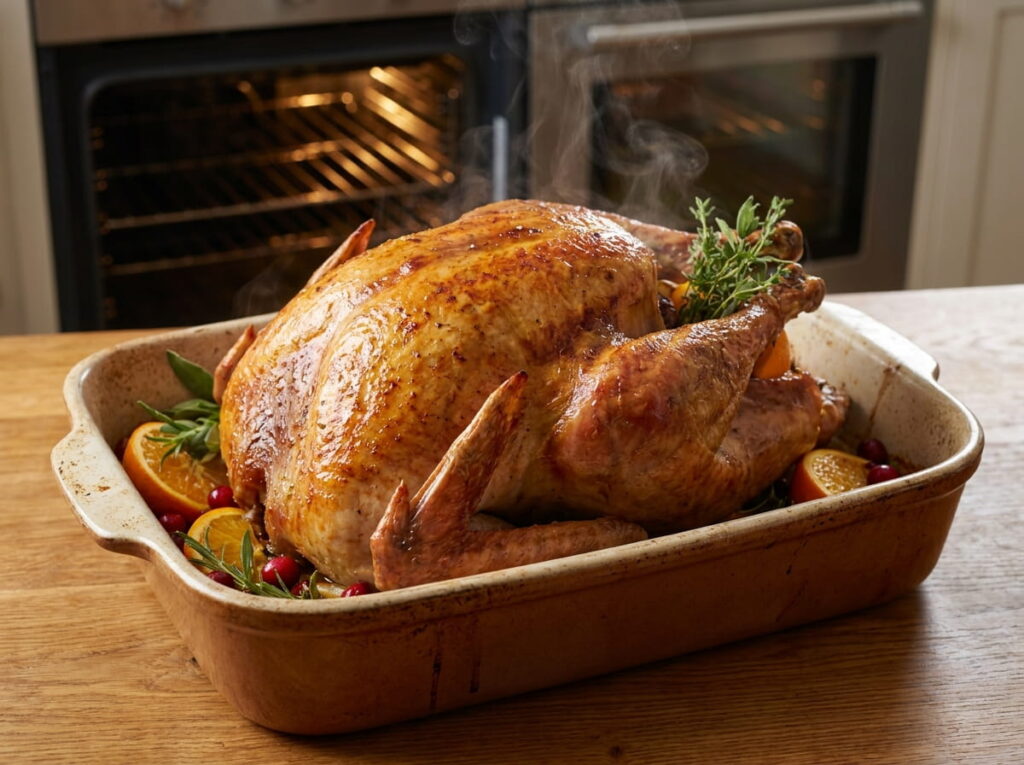
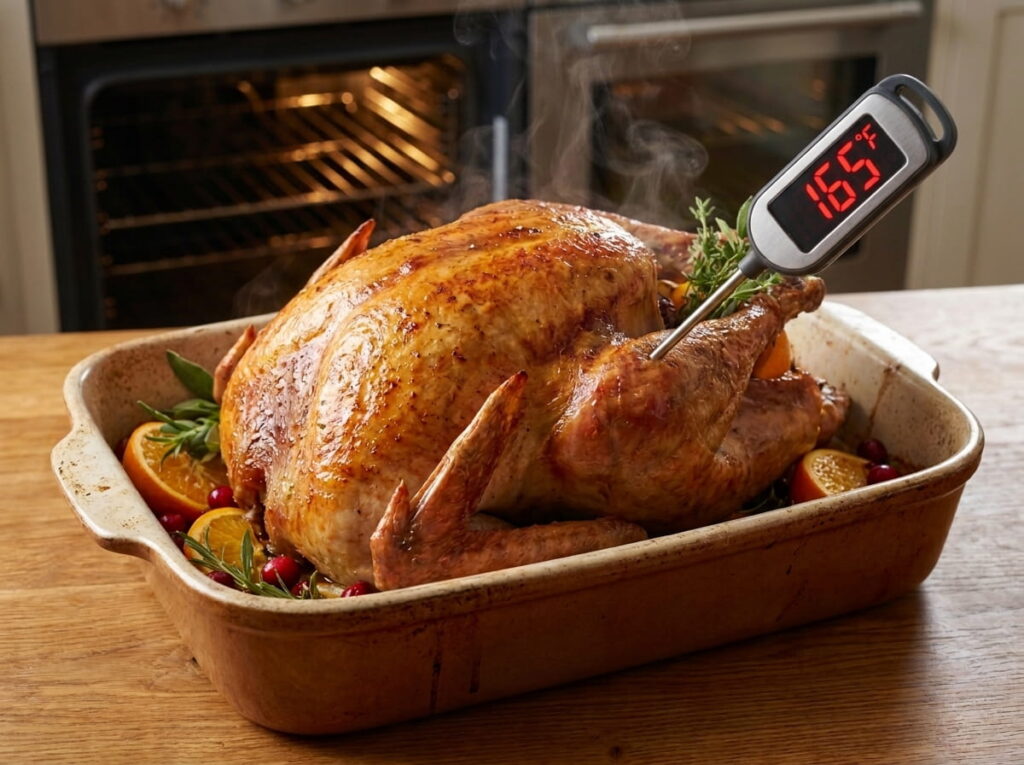
How long to cook a turkey? At 325°F (163°C), USDA’s chart puts an unstuffed 12 to 14 pound turkey at about 3 to 3¾ hours, and a 14 to 18 pound turkey at 3¾ to 4¼ hours. But the time is only an estimate. A turkey is done when a food thermometer says so, and the safe temperature isn’t the same everywhere: 165°F (74°C) in the US, 75°C in the UK, Ireland, Australia and New Zealand, and 82°C (180°F) for whole poultry in Canada.
Turkey cooking time by weight (USDA, 325°F)
These are USDA’s roasting times for a fully thawed whole turkey in a 325°F (163°C) oven.
| Turkey weight | Unstuffed | Stuffed |
|---|---|---|
| 8 to 12 lb (3.6 to 5.4 kg) | 2¾ to 3 hours | 3 to 3½ hours |
| 12 to 14 lb (5.4 to 6.4 kg) | 3 to 3¾ hours | 3½ to 4 hours |
| 14 to 18 lb (6.4 to 8.2 kg) | 3¾ to 4¼ hours | 4 to 4¼ hours |
| 18 to 20 lb (8.2 to 9.1 kg) | 4¼ to 4½ hours | 4¼ to 4¾ hours |
| 20 to 24 lb (9.1 to 10.9 kg) | 4½ to 5 hours | 4¾ to 5¼ hours |
Start checking the temperature at the low end of the range. If you’re cooking outside the US, your country’s guidance uses different oven temperatures and methods. They’re covered further down.
Plan your turkey: work backward from dinner
Pick your country, enter your turkey’s weight and the time you want to eat, and the planner works out when to start thawing, when the bird goes in the oven, when to start checking it, and the done temperature where you live. It can also add the key times to your phone’s calendar, which is more reliable than remembering at 6 a.m. on a holiday. Turkey still frozen? Our guide to how long it takes to thaw a turkey has the full thawing times by weight.
Turkey Timing Planner
Enter your turkey and your dinner time. We'll work backward to tell you when to thaw it, when it goes in the oven, when to start checking it, and the safe done temperature where you live.
Times are planning estimates from each country's published guidance. Ovens and birds vary, so a food thermometer decides when it's done, not the clock.
What temperature is a turkey done at? It depends where you live
All six countries recommend checking with a food thermometer in the thickest part of the bird. Where they differ is the number.
| Country | Done temperature | Where to measure |
|---|---|---|
| United States (USDA) | 165°F (74°C) | Thickest part of the breast, innermost part of the thigh and innermost part of the wing |
| Canada (Health Canada) | 180°F (82°C) for whole poultry | Thickest part of the inner thigh, not touching the bone |
| United Kingdom (Food Standards Scotland) | 75°C (167°F) | Thickest part, between the breast and the thigh |
| Ireland (safefood) | 75°C (167°F) | Thickest part, between the breast and the leg |
| Australia (FSANZ) | 75°C (167°F) | Thickest part of the thigh or breast |
| New Zealand (MPI) | 75°C (167°F) for 30 seconds | Middle of the thickest part |
A few details are worth knowing. New Zealand’s MPI also accepts 70°C held for 3 minutes, and notes that poultry can stay a little pink close to the bone even when it’s cooked. NSW Food Authority’s turkey guide uses at least 74°C, slightly below the 75°C that Food Standards Australia New Zealand gives for all poultry. And Canada’s 82°C is for whole birds; Health Canada’s figure for poultry pieces and ground poultry is 165°F (74°C).
A food thermometer is the only reliable way to know a turkey is done, and USDA recommends using one for both the bird and any stuffing. If you don’t have one, UK, Irish and New Zealand guidance give the same three fallback checks at the thickest part: the meat is piping hot all the way through, there’s no pink meat, and the juices run clear. These are less reliable than a thermometer, and safefood says the turkey has to pass all three.
How long to cook a turkey outside the US
Canada
Turkey Farmers of Canada publishes its chart for a conventional oven at 350°F (177°C), a little hotter than USDA’s 325°F:
| Turkey weight | Unstuffed | Stuffed |
|---|---|---|
| 8 to 10 lb (3.6 to 4.5 kg) | 2 h to 2 h 30 min | 2 h 40 min to 3 h 30 min |
| 11 to 13 lb (5.0 to 5.9 kg) | 2 h 45 min to 3 h 15 min | 3 h 40 min to 4 h 20 min |
| 14 to 16 lb (6.4 to 7.3 kg) | 3 h 30 min to 4 h | 4 h 40 min to 5 h 20 min |
| 17 to 19 lb (7.7 to 8.6 kg) | 4 h 15 min to 4 h 45 min | 5 h 40 min to 6 h 20 min |
| 20 to 22 lb (9.1 to 10.0 kg) | 5 h to 5 h 30 min | 6 h 40 min to 7 h 20 min |
| 23 to 24 lb (10.4 to 10.9 kg) | 5 h 45 min to 6 h | 7 h 40 min to 8 h |
One thing to watch: that chart times an unstuffed bird to 170°F (77°C) in the thigh, but Health Canada’s target for whole poultry is 180°F (82°C). If you’re following Health Canada, use the chart to plan, allow for the bird possibly needing longer, and let the thermometer in the thickest part of the inner thigh decide when it’s done.
United Kingdom and Ireland
Food Standards Scotland gives a formula for an unstuffed turkey in an oven preheated to 180°C (350°F, Gas Mark 4):
- Under 4.5 kg: 45 minutes per kg, plus 20 minutes
- 4.5 to 6.5 kg: 40 minutes per kg
- Over 6.5 kg: 35 minutes per kg
So a 5 kg turkey works out at about 3 hours 20 minutes. Fan ovens may cook faster, so check your oven’s manual. The same guide suggests covering the turkey with foil, removing it for the last 30 minutes to brown the skin, and basting every hour. In Ireland, safefood has a turkey cooking calculator on its website but doesn’t publish the formula behind it, so the planner above uses the Food Standards Scotland method for Irish cooks too. Either way, check for 75°C.
Australia and New Zealand
NSW Food Authority suggests an oven around 160°C to 170°C and allowing approximately 45 minutes per kilo, so a 4 kg turkey takes around 3 hours. New Zealand’s MPI doesn’t publish turkey cooking times, so the planner uses the same estimate for New Zealand.
Stuffed or unstuffed?
A stuffed turkey takes longer, and the stuffing in the middle has to get hot enough to be safe too. USDA goes as far as saying that, for optimum safety, stuffing a turkey isn’t recommended. If you do:
- Stuff it just before it goes in the oven, not the night before. NSW Food Authority is specific about this.
- Don’t overstuff. safefood suggests no more than 10% of the bird’s weight in stuffing.
- Check the centre of the stuffing with a thermometer: 165°F (74°C) in the US and Canada, 75°C in Ireland.
UK, Irish and Australian guidance only gives cooking times for an unstuffed bird, so if you stuff yours, plan for extra time and let the thermometer decide. Cooking the stuffing in a separate dish, as Food Standards Scotland recommends, avoids the problem entirely.
Can you cook a turkey from frozen?
In the US, yes. USDA says it’s safe, but it will take at least 50% longer than a thawed turkey, and you’ll need to pull the giblet packet out with tongs partway through cooking once it loosens. We couldn’t find the same allowance in the other five countries’ guidance. New Zealand’s MPI only allows cooking from frozen when the packaging instructions permit it. So outside the US, plan to thaw it fully first. Our guide to how long it takes to thaw a turkey has the times by weight for each method.
How long should a turkey rest?
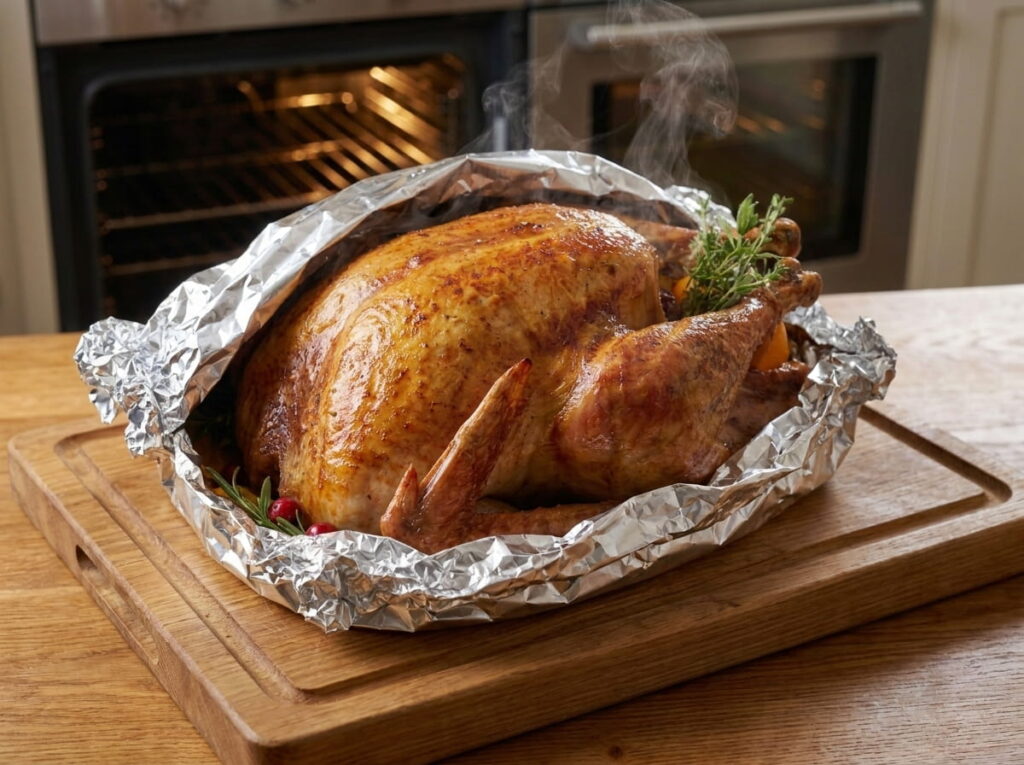
USDA and Turkey Farmers of Canada both say about 20 minutes before carving, so the juices can settle. safefood in Ireland suggests at least 30 minutes, covered loosely with foil and tea towels. The planner builds in 30 minutes, which also happens to be about how long gravy takes, so nobody is standing around guarding the oven.
Kitchen Answers Tip: Plan around the longest time in the range, then start checking at the shortest. If the turkey reaches temperature early, take it out and keep it covered while it rests. An early bird holds well; an undercooked one sends everyone back to the table hungry.
FAQ: Cooking a turkey
How long does a 20 lb turkey take to cook?
A 20 pound turkey sits at the top of USDA’s 18 to 20 pound range, so at 325°F plan on 4¼ to 4½ hours unstuffed, or 4¼ to 4¾ hours stuffed. If yours is a little over 20 pounds, use the next row up: 4½ to 5 hours unstuffed, or 4¾ to 5¼ hours stuffed. Start checking the temperature at the low end of the range.
Should I roast a turkey at 325°F or 350°F?
USDA says to set the oven no lower than 325°F, and its chart is based on 325°F. The Canadian chart uses 350°F, and UK guidance uses 180°C (about 350°F). Use the chart that matches your oven temperature rather than mixing them.
Is it safe if the turkey is still a bit pink?
Go by temperature, not colour. New Zealand’s MPI notes that poultry can stay a little pink close to the bone even when it’s properly cooked. If the thermometer reads your country’s done temperature in the thickest part, it’s cooked. If you’re relying on visual checks instead of a thermometer, UK and Irish guidance says there should be no pink meat.
My turkey is bigger than 24 pounds. How long will it take?
USDA’s chart stops at 24 pounds, and we won’t guess beyond it. Follow the cooking instructions on the package, start checking early, and rely on a food thermometer.
Do I need to wash the turkey before cooking?
No. Food Standards Scotland says never to wash a turkey. Rinsing raw poultry can splash bacteria around your sink and counters rather than removing it.
Related Kitchen Answers
About the countries in this guide
Kitchen Answers checks official guidance from six countries: the United States, Canada, the United Kingdom, Ireland, Australia and New Zealand. We chose these because each one publishes clear, detailed food safety advice in English that we can read and check directly, and because most of our readers live there.
If your country isn’t listed, that’s not because its guidance doesn’t matter. We just haven’t been able to check it ourselves yet, and we won’t guess. Your national or local food safety authority is the best place to check. If you can’t find local advice, the World Health Organization’s Five Keys to Safer Food are a reliable starting point anywhere in the world, and the Food Storage Time Finder has an International (WHO) option for the same reason. If you live somewhere hot, food left out spoils faster, so get it into the fridge sooner.
You can read more about how we check our sources on our About page.
Sources
Cooking times, temperatures and safety guidance in this article and in the planner come from the food safety authorities and producer bodies below.
- USDA FSIS — Let’s Talk Turkey: A Consumer Guide to Safely Roasting a Turkey
- FoodSafety.gov — Meat and Poultry Roasting Charts
- Health Canada — Safe internal cooking temperatures
- Turkey Farmers of Canada — Roasting a Whole Turkey
- Food Standards Scotland — Turkey cooking guide
- safefood — Use a meat thermometer to check your turkey is cooked
- safefood — Turkey cooking time calculator and cooking instructions
- NSW Food Authority — Turkey tips
- Food Standards Australia New Zealand — Food safety basics
- New Zealand Food Safety (MPI) — Food safety at home