
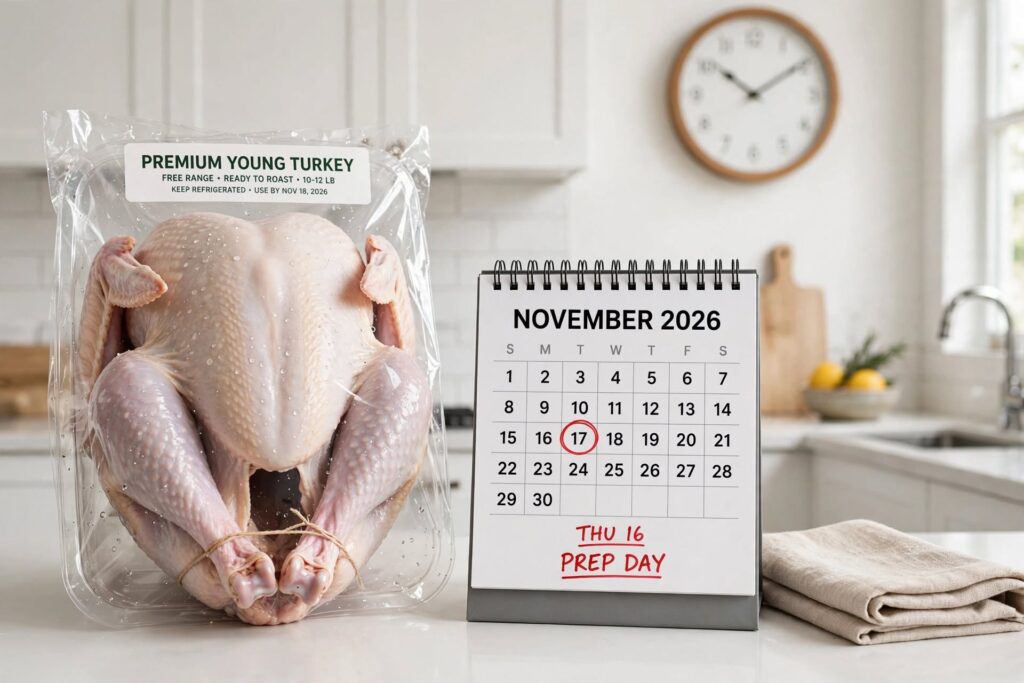
How long does it take to thaw a turkey? In the refrigerator, plan on about 24 hours for every 4 to 5 pounds — a 16-pound turkey needs roughly 4 days. In cold water, plan on about 30 minutes per pound, with the water changed every 30 minutes — the same 16-pound turkey needs about 8 hours. Never thaw a turkey on the counter at room temperature; it’s the one method every food safety agency rules out, no exceptions, no folk wisdom about “it’s cold enough in here” allowed.
Quick answer: turkey thawing time by weight
These times are for a fully frozen turkey, from USDA’s FoodSafety.gov thawing chart.
| Turkey weight | Refrigerator (40°F / 4°C or below) | Cold water (changed every 30 min) |
|---|---|---|
| 4 to 12 lbs | 1 to 3 days | 2 to 6 hours |
| 12 to 16 lbs | 3 to 4 days | 6 to 8 hours |
| 16 to 20 lbs | 4 to 5 days | 8 to 10 hours |
| 20 to 24 lbs | 5 to 6 days | 10 to 12 hours |
Why you can’t thaw a turkey at room temperature
A whole turkey is dense enough that the inside can still be frozen solid while the outer layers sit in the temperature danger zone (40°F to 140°F / 4°C to 60°C) for hours — long enough for bacteria to multiply to unsafe levels before the bird is anywhere near cooked. That’s true whether it’s sitting on the counter overnight or defrosting in a warm kitchen during the day. Every method below keeps the turkey below 40°F (4°C), or moving quickly enough through the danger zone, the entire time.
How long does it take to thaw a turkey in the refrigerator?
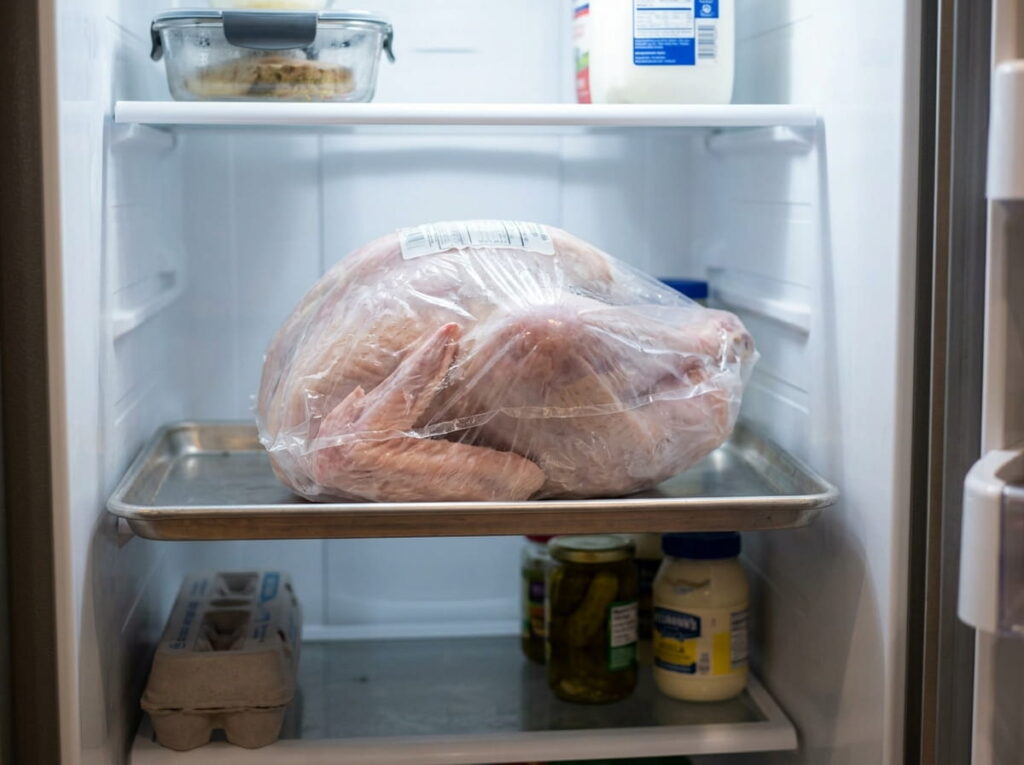
Refrigerator thawing is the method both USDA and Health Canada recommend as the safest and most hands-off. Budget about 24 hours for every 4 to 5 pounds of turkey, using the table above for exact ranges. To do it:
- Leave the turkey in its original, unopened wrapper.
- Set it breast side up on a rimmed tray or in a pan, to catch any drips.
- Keep the refrigerator at 40°F (4°C) or below the entire time.
Once it’s fully thawed, a turkey can stay in the refrigerator for another 1 to 2 days before it needs to be cooked, according to USDA’s Food Safety and Inspection Service — and if your plans change, a fridge-thawed turkey can safely be refrozen raw, as long as it’s stayed cold the whole time.
Worth knowing if you’re following Canadian guidance: Health Canada is more conservative here. It advises cooking a turkey as soon as it’s fully thawed rather than treating that 1 to 2 day window as a given, and it only allows refreezing a raw turkey that still has ice crystals on its surface — in other words, one that’s partially thawed, not fully thawed.
How long does it take to thaw a turkey in cold water?
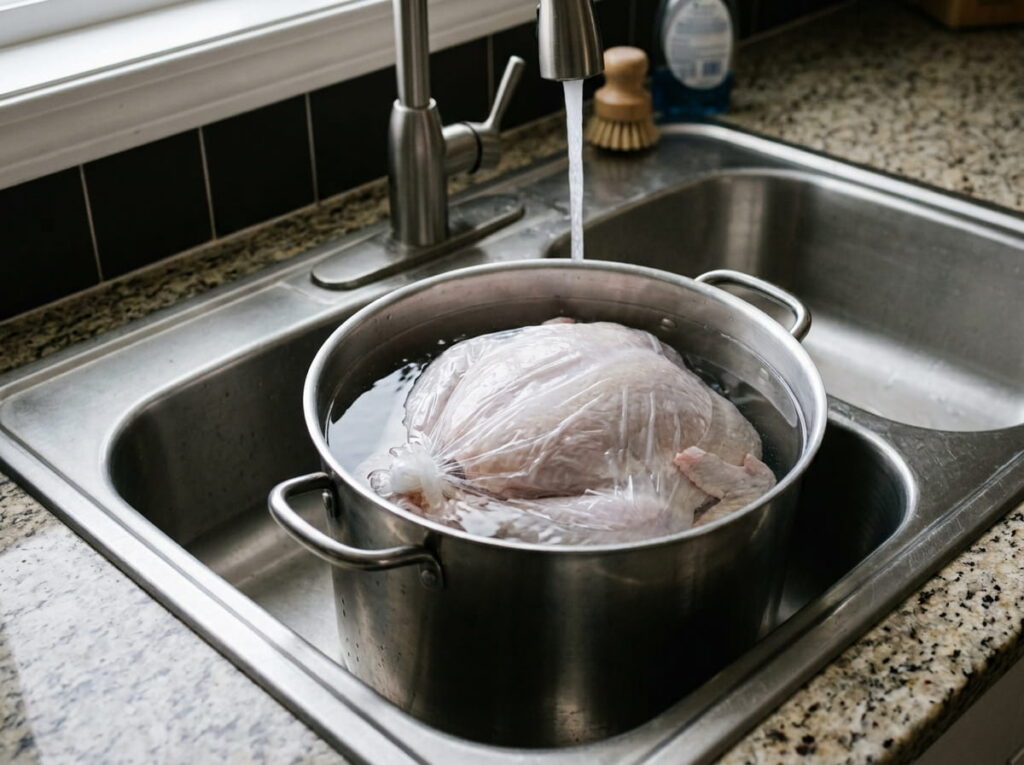
Cold water thawing is much faster — about 30 minutes per pound instead of a full day per 4 to 5 pounds — which makes it the fallback if you didn’t get the turkey into the fridge in time. To do it:
- Keep the turkey in its original leak-proof wrapper (or a heavy-duty bag if the packaging is damaged).
- Submerge it completely in cold tap water, breast side down.
- Change the water every 30 minutes so it stays cold — this is the step people most often skip, and it’s the one that actually keeps the method safe.
- If the turkey isn’t fully submerged, rotate it partway through.
A turkey thawed in cold water needs to be cooked immediately afterward — don’t put it back in the fridge to cook later, and don’t refreeze it raw.
What about microwave thawing?
Microwave thawing is the third method food safety agencies consider safe, but it’s mostly practical for smaller birds that fit the appliance, and settings vary enough by microwave that it’s worth checking your owner’s manual for turkey-specific guidance. As with cold water thawing, a microwave-thawed turkey needs to go straight into the oven — it can’t be refrigerated for later or refrozen raw.
Working backward from your holiday meal time
The easiest way to use the table above is to start from your meal, not from today’s date — the same approach works whether you’re planning around Thanksgiving, Christmas, or any other holiday built around a turkey. Pick the day and time you plan to put the turkey in the oven, then count backward:
- Find your turkey’s weight in the table and note the refrigerator thawing time.
- Count that many days back from when you need to start cooking — that’s the latest day to move the turkey from the freezer to the fridge.
- If that date has already passed, switch to the cold water method and count hours instead of days from your cooking start time.
For a 16 to 20 pound turkey and a holiday dinner, that means moving it to the fridge by the Saturday or Sunday before — later than that, and the cold water method is the more realistic option. The turkey doesn’t care about your schedule; it only cares about time and temperature.
Kitchen Answers Tip: If you’re not sure your turkey will be fully thawed in time, start checking a day early by pressing on the thickest part of the breast and the cavity opening. Fully thawed turkey feels soft all the way through; a cold, hard spot near the bone means it needs more time before it can cook evenly.
What if the turkey is still completely frozen on the morning of your meal?
If there’s genuinely no time left for the fridge or cold water methods, USDA’s guidance is that a whole turkey can be cooked directly from frozen — it’s safe, just slower. Plan on at least 50% more cooking time than the packaging or a recipe calls for, and pull out the giblet packet partway through cooking once it’s loosened enough to remove, rather than trying to get it out beforehand.
Treat this as a last resort, not a plan — and note that it’s specifically U.S. guidance. Outside the U.S., don’t assume cooking from frozen is fine unless the turkey’s own packaging says so: Australian guidance doesn’t offer a frozen-cooking option, and New Zealand’s only allows it “if the packaging instructions permit it.”
Does thawing guidance differ by country?
The physics don’t change by country — a frozen turkey takes about the same time to thaw no matter where you live — but the methods considered safe, the post-thaw cooking window, and the refreezing rules do vary. Here’s how six countries’ guidance compares:
- United States (USDA FSIS): Refrigerator, cold water, and microwave are all endorsed as safe. A fully thawed turkey can sit in the fridge another 1 to 2 days before cooking, and a raw turkey thawed in the fridge can be safely refrozen.
- Canada (Health Canada): Same three safe methods as the U.S., but more conservative on timing. Health Canada advises cooking a turkey as soon as it’s fully thawed rather than giving it a grace window, and only allows refreezing a raw turkey that still has ice crystals on it — meaning it’s partially, not fully, thawed.
- United Kingdom (Food Standards Agency): Guidance centers on refrigerator thawing, with a microwave option right before cooking — cold water thawing isn’t mentioned as an approved method. Once fully defrosted, guidance calls for cooking within 24 hours, a shorter window than the U.S. or Canada.
- Ireland (FSAI): Follows the same EU food safety framework as the UK for home thawing — the fridge is the recommended method. Separately, EU rules (which Ireland’s FSAI supports) prohibit selling poultry commercially once it’s been frozen and thawed, but that’s a rule for retailers, not a limit on how you can thaw a turkey at home.
- Australia (NSW Food Authority / Food Safety Information Council): Refrigerator thawing for a large turkey can take up to 3 days, kept at 5°C or below. Once a turkey has done any significant thawing, guidance says not to refreeze it raw — there’s no ice-crystals exception like Canada’s.
- New Zealand (MPI): The least detailed of the six — defrost in the fridge or microwave “so food cooks properly in the middle,” or cook straight from frozen if the packaging allows it. No specific weight-based timing or refreezing rule is published for whole poultry.
The short version: if you’re following U.S. or Canadian guidance, the chart above is exactly right. If you’re following UK, Irish, Australian, or New Zealand guidance, stick to fridge thawing, don’t count on cooking from frozen unless your turkey’s packaging specifically says it’s fine, and don’t refreeze a turkey once it’s fully thawed.
FAQ: Thawing a turkey
Can I thaw a turkey on the counter overnight?
No. Room-temperature thawing lets the outer layers of the turkey sit in the unsafe temperature range for too long, even overnight in a cool kitchen. Use the refrigerator, cold water, or microwave instead.
How long can a thawed turkey stay in the fridge before cooking?
About 1 to 2 days after it’s fully thawed, if it’s been thawed in the refrigerator. A turkey thawed in cold water or the microwave should be cooked right away instead.
Can you refreeze a thawed turkey?
In the U.S., only if it was thawed in the refrigerator and hasn’t been cooked — a turkey thawed by the cold water or microwave method shouldn’t be refrozen raw. Canadian guidance is stricter: Health Canada only allows refreezing a raw turkey that still has ice crystals on its surface, not one that’s fully thawed. UK, Irish, and Australian guidance generally advise against refreezing a raw turkey once it’s been thawed at all. When in doubt, cook it — then any leftovers can be frozen.
Can I leave a turkey in cold water overnight to thaw?
No. Cold water thawing needs the water changed every 30 minutes to stay safe, which means it has to be actively monitored, not left running or sitting overnight unattended.
My turkey is still partly frozen on the morning of my meal — what now?
Switch to the cold water method for the remaining frozen portion — it’s roughly four times faster than the fridge. A turkey that’s mostly thawed with just a frozen patch near the bone can also finish thawing there in a few hours; check with a thermometer or by feel before it goes in the oven — the bird won’t mind the extra minute of attention.
Do I need to remove the giblets before thawing?
You can remove them once the turkey is thawed enough for the cavity to open, which is often before the whole bird is completely thawed through. Pat the cavity dry once they’re out — USDA advises against rinsing raw poultry, since it can splash bacteria onto your sink, counters, and nearby food instead of removing it.
Related Kitchen Answers
- Food Storage
- How Long Do Leftovers Last in the Fridge?
- How Long Does Cooked Chicken Last in the Fridge?
Sources
Thawing times and safety guidance in this article come from USDA’s FoodSafety.gov thawing chart, USDA’s Food Safety and Inspection Service, Health Canada, the UK Food Standards Agency, Australia’s Food Safety Information Council and NSW Food Authority, and New Zealand Food Safety (MPI).
- FoodSafety.gov — Turkey Thawing Time Chart
- USDA FSIS — Turkey Basics: Safe Thawing
- Health Canada — Poultry Facts
- Health Canada — Safely Defrosting Foods
- UK Food Standards Agency — How to Chill, Freeze and Defrost Food Safely
- Food Safety Information Council (Australia) — Turkey Defrosting and Cooking Safely
- New Zealand Food Safety (MPI) — Safe Food Preparation, Cooking, and Storage at Home