
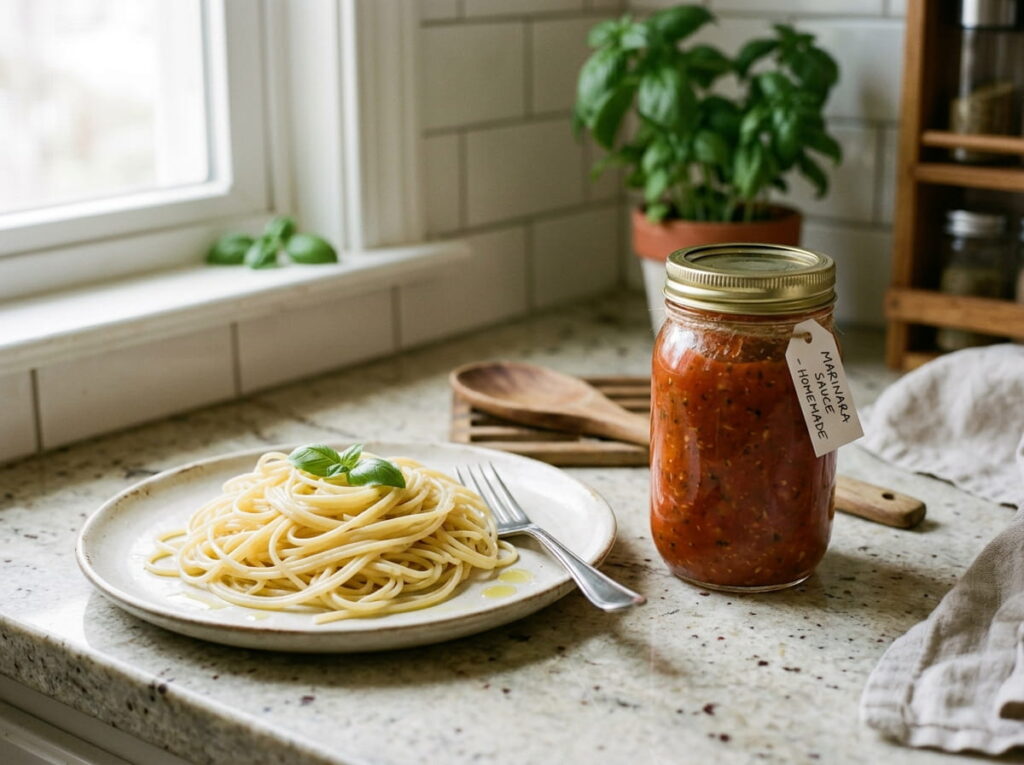
How long does spaghetti sauce last in the fridge? Homemade spaghetti sauce generally lasts 3 to 4 days when it has been stored properly. Health Canada also publishes more conservative 2 to 3 day guidance for refrigerated leftovers, while FoodSafety.gov gives 3 to 4 days for cooked meat and vegetable dishes. If you want to follow the more conservative Canadian leftovers guidance, use the sauce within 2 to 3 days. An opened jar of store-bought sauce usually lasts a bit longer, 5 to 7 days per USDA guidance for opened high-acid canned goods; that’s a different storage category from homemade leftovers, so don’t apply the 5 to 7 day figure to homemade sauce. Either way, refrigerate it within 2 hours of cooking or opening, and keep your fridge at 4°C (40°F) or below.
Quick answer
| Type of sauce | Refrigerator | Freezer |
|---|---|---|
| Homemade tomato sauce (no meat) | 3 to 4 days* | 2 to 3 months for best quality |
| Homemade meat sauce (bolognese, meat marinara) | 3 to 4 days* | 2 to 3 months for best quality |
| Sauce already mixed into cooked pasta | 3 to 4 days* | 2 to 3 months for best quality |
| Store-bought jar, opened, tomato-based | 5 to 7 days, check the label | Check product guidance |
| Unopened, shelf-stable jar | Until the best-by date, unless the label says otherwise | N/A |
| Sauce left at room temperature | Discard after 2 hours | — |
*Health Canada also recommends using refrigerated leftovers within 2 to 3 days, while FoodSafety.gov generally gives 3 to 4 days for cooked meat and vegetable dishes. The 3 to 4 day figure above follows the more specific cooked-dish storage guidance from both agencies (see “Why is there a range?” below for the full picture).
These are safety windows for sauce kept continuously cold, not a guarantee past that point. Frozen sauce kept continuously at 0°F (-18°C) stays safe indefinitely, but texture and flavor decline with time, which is why the freezer numbers above are about quality, not safety.
We’ve checked guidance for Canada, the US, the UK, Ireland, Australia and New Zealand directly. If yours isn’t listed, see how we research food storage guidance.
Why is there a range instead of one number?
Health Canada’s own guidance isn’t perfectly uniform — even the experts occasionally argue with themselves on this one. Its general leftovers page recommends eating refrigerated leftovers within 2 to 3 days, but its more specific storage chart gives 3 to 4 days for “cooked meat, stews, egg or vegetable dishes,” which is the closer match for a cooked sauce. FoodSafety.gov’s U.S. guidance also lands at 3 to 4 days for cooked meat and vegetable dishes. That’s why this article leads with 3 to 4 days as the general figure, while still naming Health Canada’s more conservative 2 to 3 day leftovers guidance for anyone who wants to follow the shorter window.
This applies to any homemade sauce: marinara, plain tomato sauce, bolognese, ground-beef spaghetti sauce, sausage and tomato sauce, or a vegetable-based sauce. For properly stored homemade sauce, both meatless and meat-based sauces generally fall within the same basic leftover storage range.
Does an unopened jar need refrigeration?
No. A commercially sealed, unopened jar of shelf-stable spaghetti sauce is fine in the pantry until its printed best-by date. Refrigeration only matters once the jar is opened, or if the label specifically says “keep refrigerated” (true of some fresh sauces sold in the refrigerated or deli section rather than the shelf-stable aisle).
How should you store spaghetti sauce in the refrigerator?
Proper storage starts before the sauce ever reaches the fridge.
Refrigerate it promptly rather than leaving a pot to cool on the stove or counter for hours. Health Canada specifically recommends refrigerating leftovers in shallow, uncovered containers so they cool quickly, then covering them once they’re cold. If you made a large batch, divide it into smaller portions first: smaller amounts cool faster and are easier to use later without reheating more than you need.
Use clean containers with tight-fitting lids once the sauce has cooled, both to prevent contamination and to keep the tomato smell from spreading to everything else in the fridge. And keep the fridge itself at 4°C (40°F) or below; an inexpensive fridge thermometer is a more reliable check than the dial setting alone.
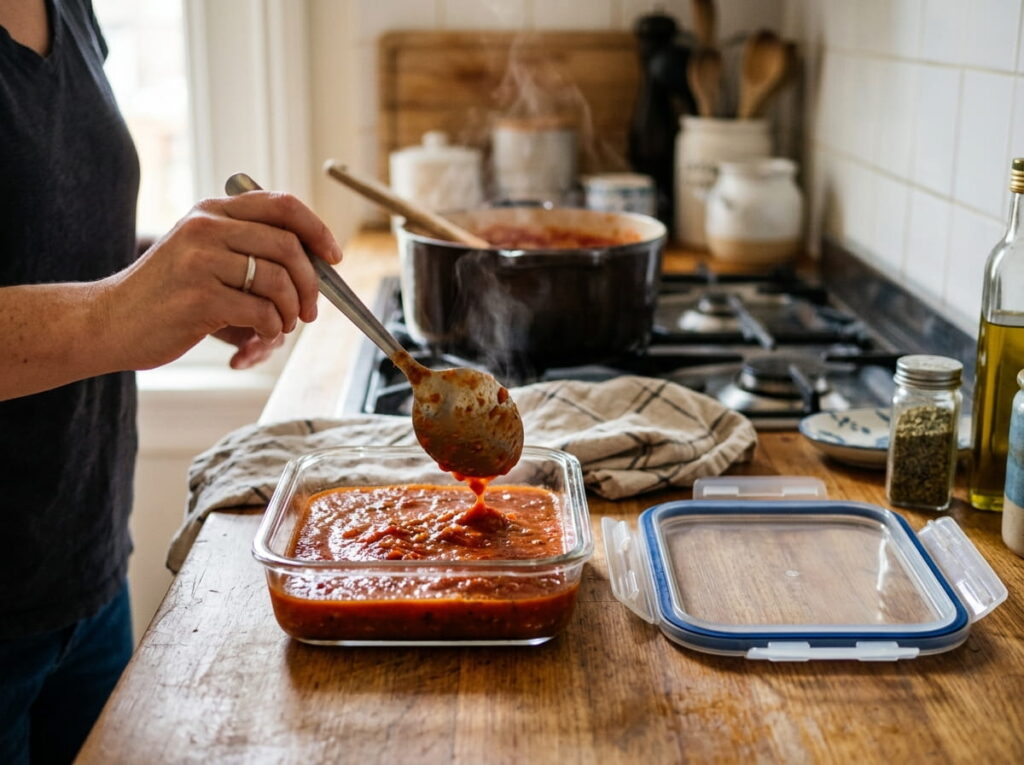
Kitchen Answers Tip: Reheat only the portion you’re about to eat instead of warming the whole container. It saves you from repeatedly heating and cooling the same batch and helps maintain better texture. Your future self will thank you the next time you don’t want to reheat an entire pot for one bowl of pasta.
How long does spaghetti sauce last after opening a jar?
Check the manufacturer’s label first. Different commercial sauces are formulated differently, and the label’s storage instructions should take priority over a general rule.
As a general guide, USDA guidance on opened high-acid canned and jarred foods (tomato products fall into this category, along with juice, fruit, pickles and sauerkraut) puts the safe refrigerator window at 5 to 7 days. That’s a different storage category from homemade leftovers, so don’t apply the 5 to 7 day figure to homemade sauce. If the label says “refrigerate after opening,” do that promptly.
Can you freeze spaghetti sauce?
Yes, and it’s the better option if you won’t use the sauce within its refrigerator window. Health Canada lists 2 to 3 months for cooked meat, stew, egg or vegetable dishes in the freezer as the best-quality range, which covers spaghetti sauce whether or not it has meat in it. It stays safe to eat well past that if it’s been kept continuously frozen, but flavor and texture start to fade.
To freeze it: let it cool and refrigerate promptly rather than freezing it hot, divide it into meal-sized portions, use freezer-safe containers or heavy-duty bags, leave a little headroom in rigid containers since liquid expands as it freezes, label it with the date, and freeze. Portioning it out is especially worth doing if you’re usually cooking for one or two people; it thaws faster and you’re not stuck defrosting more than you need for one meal.
Thawing overnight in the refrigerator is the simplest method. Once thawed in the refrigerator, treat the sauce as a refrigerated leftover and use it within the applicable storage window. Sauce thawed in the microwave should be used immediately rather than refrigerated again or refrozen. You can also reheat frozen sauce straight from frozen in a saucepan over low heat, stirring regularly so it warms evenly; reheat it to a full simmer, and use a thermometer if you want to confirm it’s reached 74°C (165°F).
How can you tell if spaghetti sauce has gone bad?
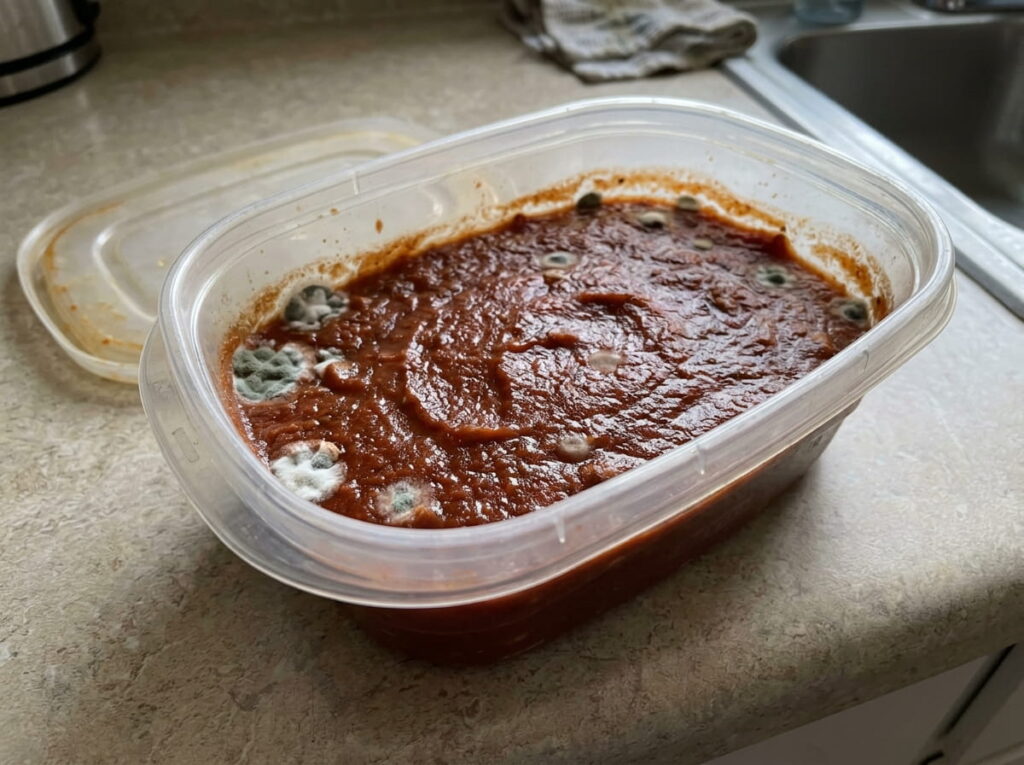
Watch for mold (white, green or fuzzy spots, sometimes only at the edges), a noticeably different color or a darker, duller shade than when it was made, bubbling or fizzing, a swollen or pressurized-looking lid, or an off, sour or fermented smell that’s different from its normal tomato-and-herb smell.
What you shouldn’t do is taste a small amount to check. Health Canada is explicit on this point: you cannot reliably judge whether food is contaminated by how it looks, smells or tastes. If a sauce has been stored longer than the timeframes above, the safer move is to throw it out even if it looks and smells fine, rather than treat those senses as a safety test.
Why has my spaghetti sauce separated?
If homemade spaghetti sauce develops a layer of oil or liquid on top, that doesn’t necessarily mean it has spoiled. Tomatoes, water, oil and other ingredients can separate during refrigeration. A quick stir usually fixes what a few hours in the fridge undid — it’s not a sign your sauce is having an identity crisis. Try stirring the sauce and reheating it gently; in many cases the ingredients come back together reasonably well. Separation by itself isn’t a reliable test of whether sauce is safe to eat, storage time and proper refrigeration are what actually matter.
Can you refreeze spaghetti sauce after thawing it?
It depends on how it was thawed and handled. If frozen sauce was thawed safely in the refrigerator and has remained properly refrigerated, refreezing may be possible, though texture and quality can suffer. Sauce thawed in the microwave should be used or cooked immediately rather than refrozen.
Is home canning a safe way to store spaghetti sauce long-term?
It can be, but only with a tested recipe and the right canning equipment. Some tested spaghetti sauce recipes, including the National Center for Home Food Preservation’s meat-based recipe, require pressure canning; use a tested recipe and follow its processing instructions exactly. That’s a different process from refrigerating or freezing, and following a verified NCHFP or extension-service canning recipe matters more than timing alone. This isn’t the place to improvise a canning process from a family recipe that was never designed for it.
Frequently asked questions
How long does spaghetti sauce last in the fridge?
Generally 3 to 4 days when refrigerated promptly and kept at 4°C (40°F) or below. Health Canada also publishes a more conservative 2 to 3 day figure for general leftovers, so use that shorter window if you’d rather follow the more cautious guidance.
How long does spaghetti sauce last after opening a jar?
Check the label first, since commercial sauces vary. As a general USDA-based guideline for opened high-acid canned or jarred foods like tomato products, 5 to 7 days refrigerated is typical.
Can I freeze spaghetti sauce?
Yes. Freeze it in meal-sized portions in freezer-safe containers or bags, ideally within its normal refrigerator window rather than after it’s already close to the end of it. It keeps its best quality for about 2 to 3 months, and stays safe well beyond that if it’s been kept continuously frozen.
Can I eat spaghetti sauce after 5 days in the fridge?
No, not for homemade sauce. Both Health Canada’s and FoodSafety.gov’s guidance put the safe window at 4 days or under for cooked leftovers. An opened jar of commercial sauce might still be within its own window at 5 days depending on the label, but homemade sauce should be used or frozen before that point.
Does spaghetti sauce go bad in the fridge even if it looks and smells fine?
Yes. Refrigeration slows bacterial growth but doesn’t stop it, and food can become unsafe before there’s any visible or detectable sign. That’s why the storage windows above matter even when a sauce seems fine.
Can I leave spaghetti sauce out overnight?
No. Cooked sauce left at room temperature for more than 2 hours (1 hour if the room is hotter than 90°F/32°C) should be discarded rather than refrigerated and used later.
Food Storage Time Finder
Want to check how long something else actually keeps in the fridge or freezer?
Related Kitchen Answers
- Food Storage
- How Long Do Leftovers Last in the Fridge?
- How Long Does Cooked Chicken Last in the Fridge?
- Is Freezer-Burned Food Still Safe to Eat?
Sources and further reading
- Health Canada: Food safety tips for leftovers
- Health Canada: Safe food storage
- FoodSafety.gov: Cold Food Storage Chart
- National Center for Home Food Preservation: Spaghetti Sauce with Meat
- National Center for Home Food Preservation: Spaghetti Sauce without Meat
- FoodSafety.gov: Refrigerated Food and Power Outages